
Blog
How a Roth Conversion of Self-Directed IRA Assets Can Trigger Higher Medicare IRMAA Premiums
A Roth conversion of a self-directed IRA asset is taxed on its appraised fair market value, and that income can push your Medicare IRMAA surcharge into a higher bracket two years later. This guide shows how to get the appraisal right before you convert, not after, so you can model the premium impact in advance.
If your self-directed IRA holds a closely held business interest, a rental property, or a private placement, converting that asset to a Roth is not the same transaction as converting a brokerage account full of mutual funds. The taxable amount is set by the asset's appraised fair market value on the conversion date, and that figure does more than determine your tax bill. It flows into the modified adjusted gross income the Social Security Administration checks two years later to decide your Medicare Part B and Part D premiums. An inflated or sloppy valuation can quietly bump you into a higher IRMAA tier for an entire year, long after the conversion is done and the appraisal can no longer be revisited.
Our appraisers prepare the independent, USPAP-compliant valuations that custodians require for fractional and hard-to-value interest conversions, and this article walks through why getting that number right before you convert, rather than after, is the linchpin of the whole decision.
What Is IRMAA and How Does a Roth Conversion Affect It?
IRMAA (the Income-Related Monthly Adjustment Amount) is a surcharge added to standard Medicare Part B and Part D premiums when a beneficiary's modified adjusted gross income exceeds set thresholds. The Social Security Administration determines IRMAA using the MAGI reported on the federal tax return filed two years before the premium year, so 2026 premiums are generally based on 2024 income and 2028 premiums on 2026 income, per SSA's handbook on IRMAA determinations.
A Roth conversion adds to that income in the year it happens. The taxable portion of converting a traditional, SEP, or SIMPLE IRA to a Roth IRA is included in gross income, and the IRS's guidance on modified adjusted gross income specifically identifies Roth conversion income as a line item that affects MAGI calculations used for other federal programs. Two years later, that one-time spike can land you in a higher IRMAA bracket even if your ordinary income never changes.
Key takeaway: the appraisal does not create the IRMAA exposure directly. The taxable conversion income it produces does, and that income is set entirely by the fair market value used on the conversion date.
How Is a Self-Directed IRA Asset Valued for an In-Kind Roth Conversion?
When you convert an illiquid self-directed IRA asset in kind, rather than selling it first, the IRS treats the fair market value of the property on the conversion date as the amount converted, not your original purchase price or the custodian's book value. IRS Publication 590-A covers how IRA distributions and conversions are valued and reported, and most custodians will not process an in-kind conversion of an illiquid asset without a current, independent valuation on file.
The appropriate method depends on the asset:
- Closely held business interests: typically valued using discounted cash flow analysis or guideline company comparisons, with marketability and minority interest discounts applied where the interest lacks control or a ready market. These are the methodologies recognized by organizations such as the ASA and NACVA.
- Real estate held in the IRA: usually valued with the sales comparison approach, supported by an income capitalization analysis for income-producing property.
- Private placements and fund interests: valued using the fund's most recent audited net asset value alongside market-based adjustments for liquidity restrictions and redemption terms.
An appraisal that is too high overstates the conversion's taxable income and can push a beneficiary into an unnecessary IRMAA tier. An appraisal that is too low understates taxable income, which creates its own tax exposure and, in a worst case, prohibited-transaction risk with the IRA. Neither error is harmless, which is why the valuation needs to stand on its own before the conversion is filed, not get reconstructed afterward to justify a number someone wanted.
2026 Medicare IRMAA Brackets: Why a Few Dollars of MAGI Matter
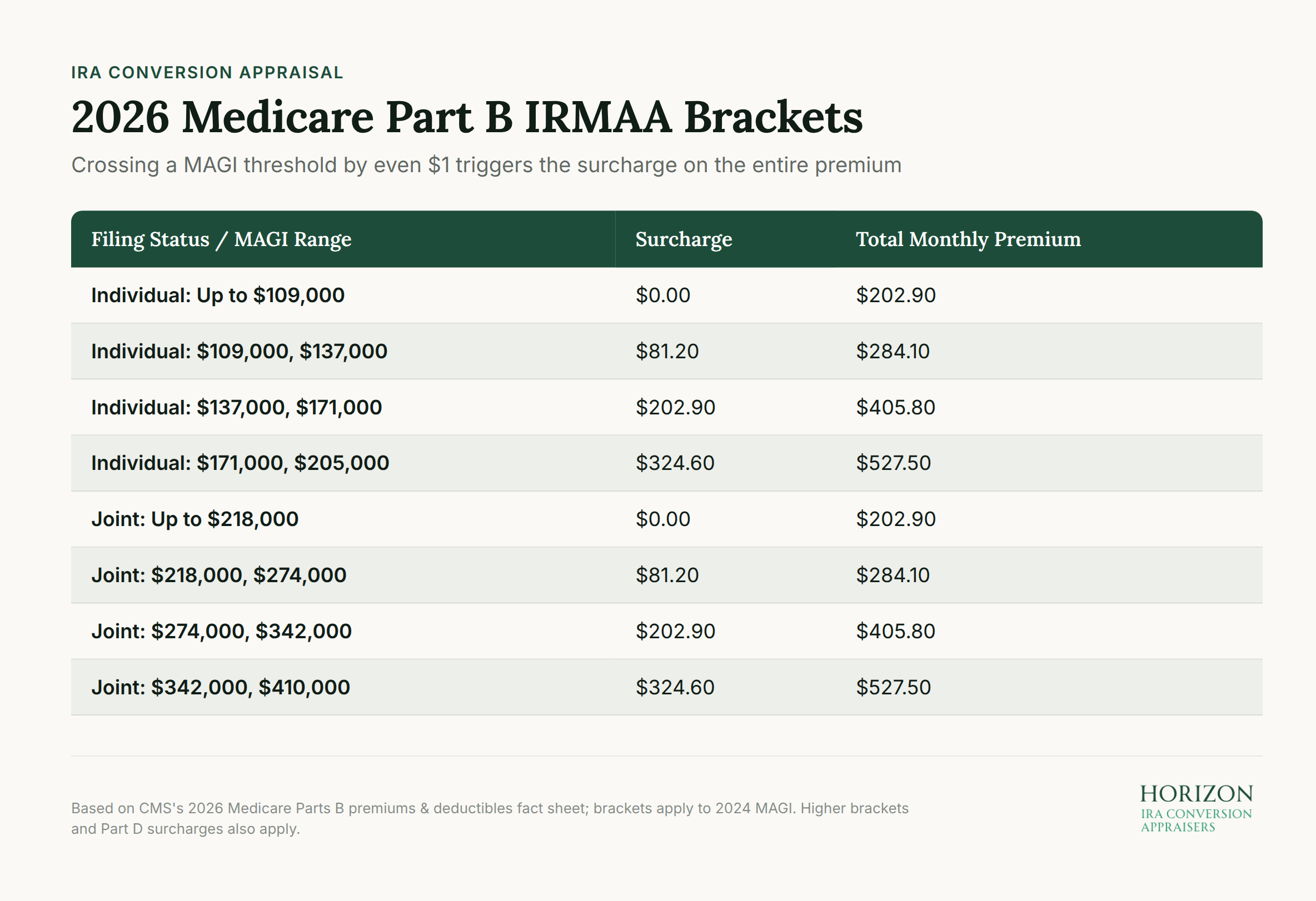
IRMAA brackets work like a cliff rather than a ramp. Crossing a threshold by even $1 of MAGI applies the surcharge to the entire premium for that tier, not just the amount above the line. The Centers for Medicare & Medicaid Services publishes the income tiers and premium amounts each year, and the 2026 Medicare Part B premium fact sheet lays out the brackets that will apply to 2024 MAGI.
The following table summarizes the 2026 Part B thresholds and total monthly premiums.
| Filing Status | MAGI Range | 2026 Part B IRMAA Surcharge | Total Monthly Part B Premium |
|---|---|---|---|
| Individual | Up to $109,000 | $0.00 | $202.90 |
| Individual | $109,000 to $137,000 | $81.20 | $284.10 |
| Individual | $137,000 to $171,000 | $202.90 | $405.80 |
| Individual | $171,000 to $205,000 | $324.60 | $527.50 |
| Joint return | Up to $218,000 | $0.00 | $202.90 |
| Joint return | $218,000 to $274,000 | $81.20 | $284.10 |
| Joint return | $274,000 to $342,000 | $202.90 | $405.80 |
| Joint return | $342,000 to $410,000 | $324.60 | $527.50 |
CMS publishes additional, higher brackets above these ranges. Part D carries its own IRMAA surcharge on top of whatever plan premium the beneficiary already pays, and it uses the same MAGI tiers.
Watch out: because the brackets apply to the whole premium once crossed, a conversion that lands MAGI just $500 over a threshold can cost thousands of dollars more in combined Part B and Part D premiums over the year, not just a few hundred.
Worked Example: A $450,000 Rental Property Conversion
Suppose a self-directed IRA holds a rental property that an independent appraiser values at $450,000 as of the conversion date, using the sales comparison approach supported by comparable rental sales in the area. The IRA owner, filing individually, otherwise expects about $95,000 in MAGI for the conversion year from Social Security, pension income, and investment interest.
If the owner converts the full $450,000 in one tax year, taxable income for that year jumps to roughly $545,000 before considering any other deductions. Two years later, that figure is the MAGI the Social Security Administration checks. At the 2026 brackets shown above, $545,000 in MAGI for an individual filer falls well above the $205,000 ceiling shown here and into one of the higher tiers CMS publishes for the highest-income beneficiaries, meaning both the Part B and Part D surcharges would land near the top of the scale for that entire premium year.
Now compare a partial conversion. If the owner converts $150,000 of the same property's value in year one and the remainder across two subsequent years, MAGI in each conversion year stays closer to $245,000. That is still well above the $205,000 individual ceiling in the table above, but it is a materially smaller jump than converting the full amount at once, and it may land in a different, lower IRMAA bracket depending on the owner's other income that year.
This example is hypothetical and illustrative only. It is not a recommendation to convert in full, in part, or across multiple years. The point is narrower: the appraised value is the input that determines which bracket the owner lands in two years later, so the appraisal has to exist, and has to be defensible, before the conversion decision gets made.
How to Model the IRMAA Impact Before You Convert
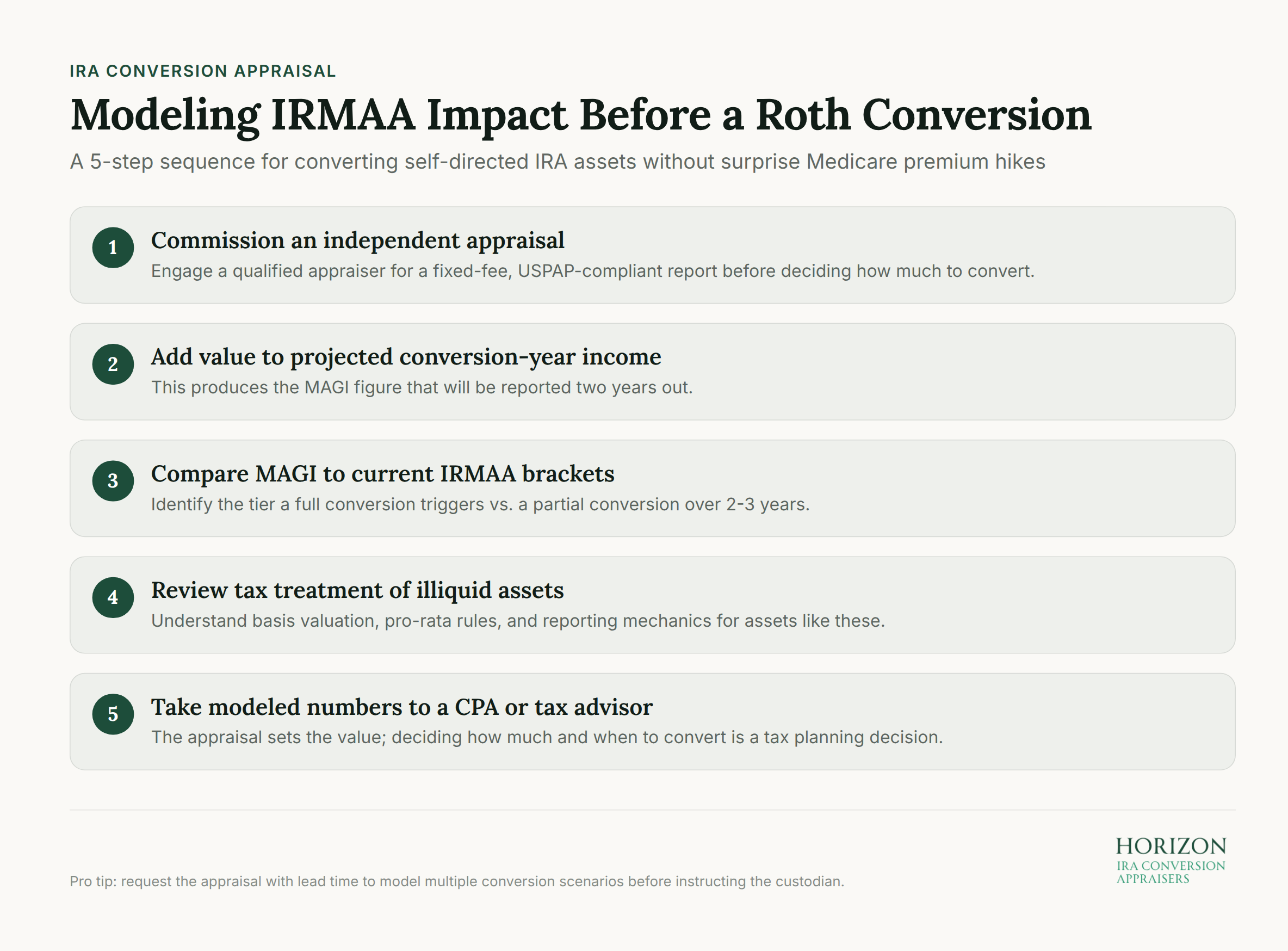
A Roth conversion of an illiquid, self-directed IRA asset should be modeled, not guessed at, and the appraisal comes first in that sequence.
- Commission an independent appraisal of the asset. Engage a qualified appraiser before you decide how much to convert or in how many years. Our appraisers prepare fixed-fee, USPAP-compliant reports scoped to the asset type, whether that is a business interest, rental property, or private placement.
- Add the appraised value to your projected conversion-year income. This gives you the MAGI figure that will be reported two years out.
- Compare that MAGI to the current IRMAA brackets. Identify which tier the full conversion would land in, and what a partial conversion across two or three years would look like instead.
- Review how the conversion's tax treatment is handled for illiquid assets. Our guide on how a Roth conversion is taxed when you convert an illiquid asset covers the mechanics of valuing basis, pro-rata rules, and reporting for assets like these.
- Take the modeled numbers to a CPA or tax advisor. The appraisal establishes the value; the decision about how much to convert, and when, is a tax and financial planning question that belongs with a qualified advisor, not an appraiser.
Pro tip: request the appraisal with enough lead time to model two or three conversion scenarios (full conversion, 50/50 split, or a three-year spread) before you instruct the custodian to process anything. Once the conversion is reported, the appraised value used that year is difficult to revisit.
Can You Undo IRMAA After a Roth Conversion?
Generally, no. The Social Security Administration allows beneficiaries to request a new IRMAA determination using Form SSA-44, but only when a qualifying life-changing event reduces income, such as marriage, divorce, death of a spouse, work stoppage, or loss of pension income. A Roth conversion by itself is not one of the listed life-changing events, and a later decline in income does not erase an IRMAA surcharge that was triggered by a prior year's conversion.
What a beneficiary can contest is an incorrect income record, such as a tax return amendment or a documented error in how the conversion was valued or reported. That is a separate process from a life-changing event request, and it depends on the facts of the original filing and appraisal, not on regret about the IRMAA outcome. This is one more reason the appraisal needs to be defensible from the start: it is far harder to challenge a completed conversion's reported value than it is to get that value right before the transaction happens.
Getting the Valuation Right Is the Linchpin
The chain that matters here runs in one direction: a defensible appraisal sets the conversion's reported value, that value becomes taxable conversion income, that income enters MAGI, and MAGI determines the IRMAA tier applied two years later. Every step after the appraisal is largely mechanical. The appraisal itself is the one place where judgment, methodology, and documentation genuinely matter, and it is the only step you control before the conversion is filed.
If your self-directed IRA holds a business interest, real estate, or a private placement you are considering converting, have the asset appraised first, model the IRMAA impact against the current brackets, and then bring both numbers to your CPA before you decide how much to convert and when. Our appraisers can prepare the fair market value report your custodian and your tax advisor will both need to make that decision with real numbers instead of estimates.
This article is provided for general informational purposes only and does not constitute legal, tax, or financial advice. Readers should consult a qualified attorney or CPA regarding their specific circumstances.