
Blog
How Is a Roth Conversion Taxed When You Convert an Illiquid Asset?
Converting a rental property, private stock, or crypto position out of a traditional IRA triggers ordinary income tax on the appraised fair market value, with no market price to check the number against. This guide walks through the Form 8606 math, the 2025 bracket stacking, IRMAA exposure, and a full worked example.
Converting an illiquid asset out of a traditional IRA works the same way on paper as converting a mutual fund: the value that leaves the pre-tax account becomes ordinary income in the year of conversion. The difference is that a mutual fund has a closing price on the day you convert. A rental property, a parcel of private company stock, or a crypto position held inside a self-directed IRA does not. Someone has to put a number on it, and whatever number they land on is the number the IRS taxes.
This matters more than most people expect. Because there's no market quote to fall back on, the appraisal itself becomes the tax event. Get the fair market value wrong and you either overpay tax on income you never should have recognized, or you understate it and create a defensibility problem down the road. Our Roth IRA conversion appraisal team prepares USPAP-consistent fair market value reports specifically for real estate, private company stock, and cryptocurrency held in self-directed IRAs, timed to support the conversion basis a custodian and the IRS will both rely on.
How Roth Conversion Income Is Calculated
A Roth conversion is taxed as ordinary income in the year of conversion, based on the fair market value of the assets moved out of the traditional IRA, reduced by any after-tax basis you're entitled to recover under the pro-rata rule. There is no special conversion tax rate and no capital gains treatment, even if the asset itself would have qualified for long-term capital gains treatment outside an IRA.
Any conversion from a traditional, SEP, or SIMPLE IRA to a Roth IRA has to be reported on Form 8606, and Part II of that form is where the taxable share gets calculated. If you have ever made nondeductible contributions to a traditional IRA, you carry basis, and that basis has to be spread across every traditional, SEP, and SIMPLE IRA you own, not just the account holding the asset you're converting.
The Form 8606 instructions lay out the pro-rata mechanics in four steps:
- Total basis: Add up your after-tax contributions and any basis carried forward from prior years.
- Year-end IRA value: Total the fair market value of all your traditional, SEP, and SIMPLE IRAs as of December 31 of the conversion year.
- Add back distributions and conversions: Add the year's total distributions and conversions to that year-end value.
- Compute the nontaxable fraction: Divide total basis by the sum from the previous step, then apply that fraction to the amount converted.
The result is a single blended percentage. You cannot choose to convert only the after-tax portion of an account and call it tax-free; every dollar converted carries the same nontaxable percentage as the rest of your IRA money, as industry guidance on the pro-rata rule explains. This is often the biggest surprise for people converting an illiquid asset, since they assume the conversion is a clean, isolated transaction when it's actually pooled with every other traditional IRA dollar they hold.
Why the Appraisal's Value Is the Number the IRS Taxes
For a liquid asset, the market sets the value and the appraisal question never comes up. For an illiquid asset converted in-kind, the appraised fair market value on the conversion date IS the amount treated as distributed and converted, full stop. There's no secondary check against a ticker price, so the report itself carries the entire weight of the tax calculation.
That cuts both ways. An appraisal that comes in too high inflates your taxable income for the year, sometimes by a large margin on assets like closely held stock or a multi-unit rental property. An appraisal that comes in too low, or one that isn't defensible, creates exposure if the account is ever reviewed, since your custodian is separately reporting the same fair market value to the IRS on Form 5498 each year.
Watch out: A stale appraisal, one pulled from a refinance two years ago or a back-of-envelope estimate from a broker, is not the same thing as a fair market value opinion prepared for a specific conversion date. Custodians increasingly require a current, independent valuation before they will process an in-kind conversion of real estate, private equity, or crypto.
Our appraisers hold credentials with organizations such as the ASA and ISA depending on the asset class, and every conversion valuation is prepared in accordance with USPAP so the number stands up to scrutiny from both the custodian and, if it ever comes to that, a reviewer at the IRS. Because these engagements are scoped individually (a single-family rental is a different job than a minority stake in a private manufacturing company) the fee is quoted as a fixed fee after we understand the asset and the intended use, never billed hourly.
How Conversion Income Stacks on Top of Your Ordinary Income
Conversion income does not get its own tax bracket. It lands on top of your wages, business income, pension income, and everything else on your return, and it's taxed at whatever marginal rate that combined total reaches. A large illiquid conversion can push a taxpayer through two or three brackets in a single year.
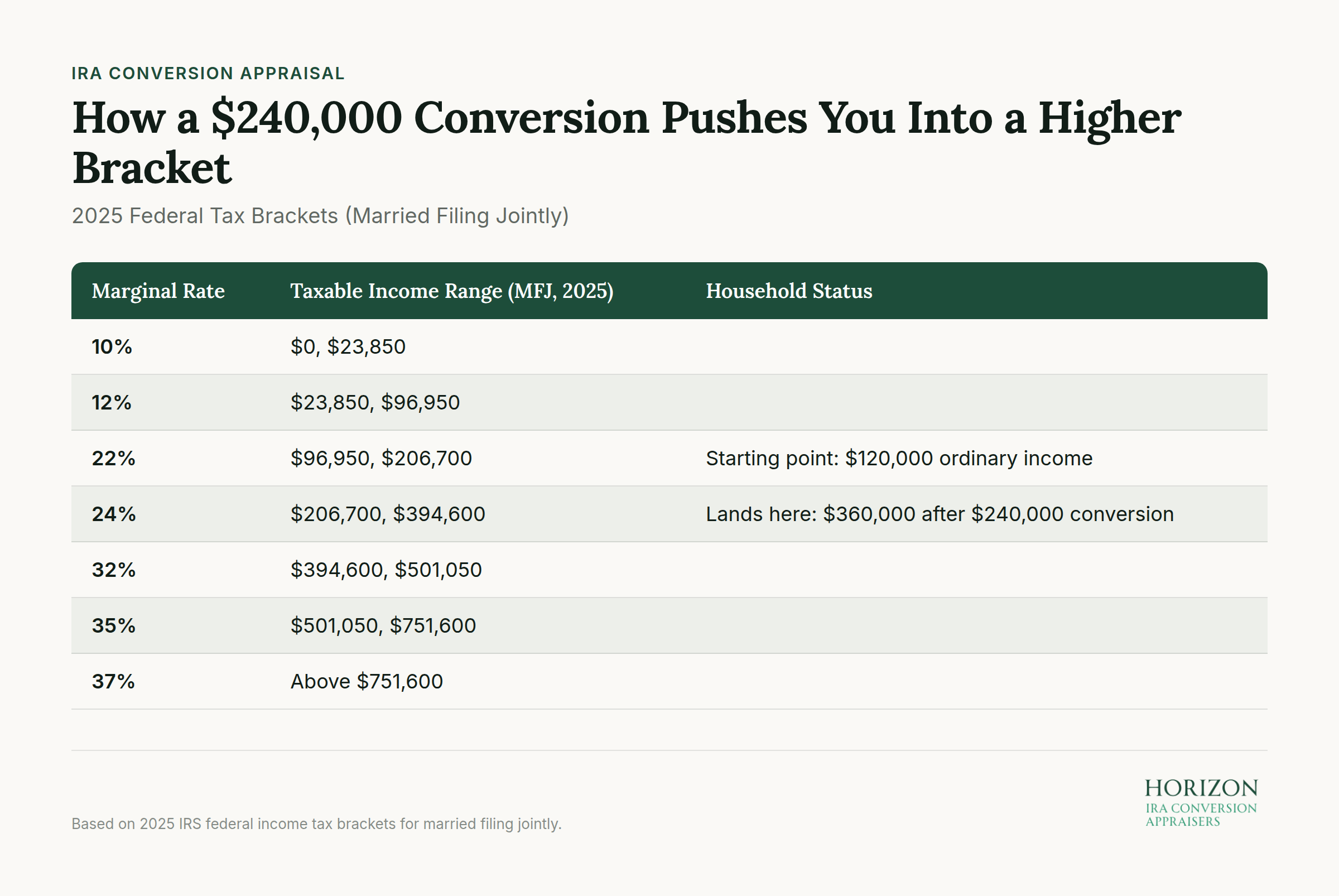
The 2025 federal income tax brackets for a married couple filing jointly illustrate how quickly this happens:
| Marginal Rate | Taxable Income Range (MFJ, 2025) |
|---|---|
| 10% | $0 to $23,850 |
| 12% | $23,850 to $96,950 |
| 22% | $96,950 to $206,700 |
| 24% | $206,700 to $394,600 |
| 32% | $394,600 to $501,050 |
| 35% | $501,050 to $751,600 |
| 37% | Above $751,600 |
A household already sitting at $120,000 of ordinary taxable income is comfortably in the 22% bracket before any conversion. Add $240,000 of appraised, taxable conversion income from a private stock parcel, and total taxable income jumps to $360,000, well into the 24% bracket. The conversion doesn't just get taxed at 22%; it fills the rest of the 22% bracket first, then spills into 24% for everything above $206,700.
Medicare IRMAA and the Net Investment Income Tax
A large conversion can raise your Medicare premiums two years later, even though Roth conversion income itself is exempt from the Net Investment Income Tax. Both issues run through the same figure: modified adjusted gross income (MAGI) for the year of conversion.
Medicare's Income-Related Monthly Adjustment Amount (IRMAA) uses a two-year lookback, so a conversion completed in 2025 affects Part B and Part D premiums in 2027. The surcharge tiers step up in bands as MAGI rises, and a six-figure conversion can push a retiree from the base premium tier straight into one of the higher surcharge brackets, adding thousands of dollars a year to Medicare costs at a time when the household may not even be working anymore.
The Net Investment Income Tax (NIIT), a 3.8% surtax under IRC §1411, applies once MAGI crosses $250,000 for joint filers or $200,000 for single filers. The conversion income itself is not counted as net investment income and doesn't get hit with the 3.8% surtax directly, a point confirmed by industry guidance on Roth conversion tax treatment. But because the conversion raises overall MAGI, it can pull other investment income (dividends, capital gains, rental income) over the NIIT threshold for the first time, even though none of that income changed.
Pro tip: Run the IRMAA and NIIT numbers before you convert, not after. A conversion sized to stay just under a bracket or surcharge threshold can save more in premiums and surtax than the marginal income tax difference alone.
A Worked Example: Converting an Appraised Private Stock Parcel
Here's how the math plays out for a married couple converting a parcel of private company stock, using round numbers to keep the mechanics clear.
The setup:
- Traditional IRA A holds a private stock parcel appraised at $250,000, funded entirely with pre-tax rollover dollars.
- Traditional IRA B holds $50,000 in cash, of which $10,000 represents after-tax, nondeductible contributions (basis).
- The couple converts the entire $250,000 stock position from IRA A and leaves IRA B untouched.
- The couple's other 2025 ordinary taxable income is $120,000.
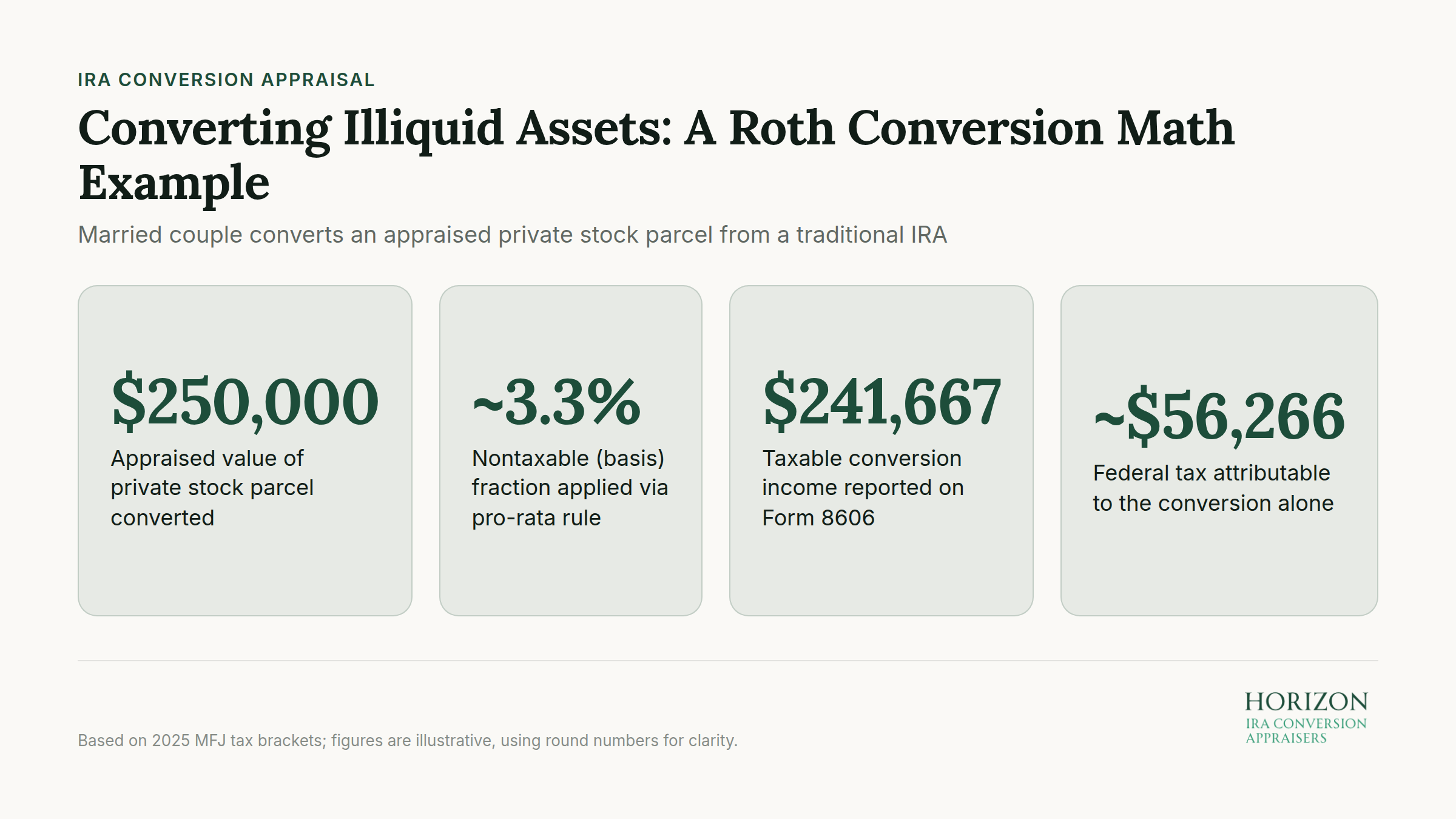
Step 1: Compute the pro-rata fraction. Total basis across both IRAs is $10,000. Year-end IRA value ($50,000 remaining in IRA B) plus the conversion amount ($250,000) equals $300,000. The nontaxable fraction is $10,000 divided by $300,000, or roughly 3.3%.
Step 2: Apply the fraction to the conversion. Of the $250,000 converted, about $8,333 (3.3%) comes out tax-free as basis. The remaining $241,667 is taxable ordinary income, reported on Form 8606 Part II and carried to the couple's Form 1040.
Step 3: Stack it on ordinary income. Adding $241,667 to $120,000 of other income brings total taxable income to $361,667. Using the 2025 MFJ brackets above, about $86,700 of that conversion income is taxed at 22% (filling the rest of that bracket) and the remaining roughly $154,967 is taxed at 24%. That works out to approximately $19,074 plus $37,192, or about $56,266 in federal tax attributable to the conversion alone, before state tax. In a high-tax state the state bill compounds the federal one: California, for example, taxes the converted amount as ordinary income in the year of conversion, on top of whatever is owed to the IRS, which is why an independent California IRA conversion appraisal has to hold up with two taxing authorities rather than one.
Step 4: Check the secondary effects. MAGI for the year lands at $361,667, comfortably above the NIIT threshold and high enough to trigger one of the higher IRMAA surcharge tiers on Medicare premiums two years later.
Example: If that same $250,000 stock parcel had been appraised at $220,000 instead of $250,000 because the valuation date was six months stale and missed a recent funding round, the couple would have understated taxable conversion income by roughly $30,000, a discrepancy a reviewer could flag if the custodian's Form 5498 reporting and the conversion paperwork don't match.
Practical Ways to Manage the Tax Bill on an Illiquid Conversion
Three habits consistently keep illiquid conversions from turning into a tax surprise:
- Time the appraisal to the conversion date. An appraisal effective within a tight window of the actual conversion date holds up better with custodians and reviewers than one pulled from an old refinance, buy-sell agreement, or informal estimate.
- Pay the tax bill from outside funds. Withholding the tax from the IRA itself reduces the amount that actually reaches Roth status and, if you're under 59 1/2, can trigger an early withdrawal penalty on the withheld portion. Paying from a taxable account preserves the full converted amount inside the Roth.
- Consider a partial or multi-year conversion. Splitting a large illiquid asset's value across two or three tax years, where the asset structure allows it, can keep more of the income out of the top marginal brackets and reduce IRMAA exposure in any single lookback year.
Key takeaway: The tax rules for converting an illiquid asset are identical to the rules for converting cash or securities. What changes is that a defensible, dated fair market value appraisal becomes the single input that determines the entire tax bill, since there's no market price standing behind it.
Get the Valuation Right Before You Convert
An illiquid asset conversion lives or dies on the quality of its fair market value determination. Once that number is set, the pro-rata math on Form 8606 and the bracket stacking that follows are mechanical, but the appraisal itself is where most of the risk and most of the tax exposure actually sit. If you're planning to convert real estate, private company stock, or cryptocurrency out of a self-directed IRA, get the fair market value scoped and completed before you lock in a conversion date, not after.
Request an appraisal to get a fixed-fee, USPAP-consistent fair market value report timed to support your Roth conversion.
This article is provided for general informational purposes only and does not constitute legal, tax, or financial advice. Readers should consult a qualified attorney or CPA regarding their specific circumstances.