Blog
How to Value Alternative Assets in a SDIRA for Form 5498 Reporting
Every alternative asset in a SDIRA, from rental property to private equity, needs an annual fair market value for IRS Form 5498. This guide explains who is responsible for that valuation, which asset types trigger extra reporting, and what happens when the number is missing or wrong.
If you hold real estate, private equity, or a closely held business interest inside a self-directed IRA, someone has to put a number on it every single year, whether or not that asset ever trades hands. That number feeds directly into an IRS form, your required minimum distribution calculation, and your account's audit exposure. This guide walks through the Form 5498 reporting requirement, which assets qualify as alternative assets in a SDIRA, who actually has to obtain the valuation, and what goes wrong when nobody does.
What Counts as an Alternative Asset in a SDIRA?
An alternative asset in a SDIRA is any holding that doesn't trade on a public exchange and therefore has no daily market quote to fall back on. Unlike a mutual fund or listed stock, these assets require someone to actively determine what they're worth.
The IRS identifies a specific list of "specified assets" that trigger extra reporting on Form 5498, and this list lines up closely with what the industry calls alternative assets. Per the IRS's guidance on Form 5498 asset codes, the categories include:
- Stock or another ownership interest in a corporation that isn't readily tradable on an established securities market.
- Short-term or long-term debt obligations not traded on an established securities market, such as private notes.
- Ownership interests in an LLC or similar entity, unless that interest trades on an established market.
- Real estate held directly by the IRA.
- Ownership interests in a partnership, trust, or similar entity, unless it trades on an established market.
- Option contracts not offered for trade on an established options exchange.
- Any other asset without a readily available fair market value.
In practice, this means the assets our clients most often need appraised are direct real estate holdings, private equity and private placement interests, closely held business stakes, private promissory notes, and occasionally precious metals or specialized collectibles held through an approved structure. Publicly traded stocks and standard mutual funds don't fall into this bucket, because their value is a quote away.
The IRS Form 5498 Fair Market Value Requirement
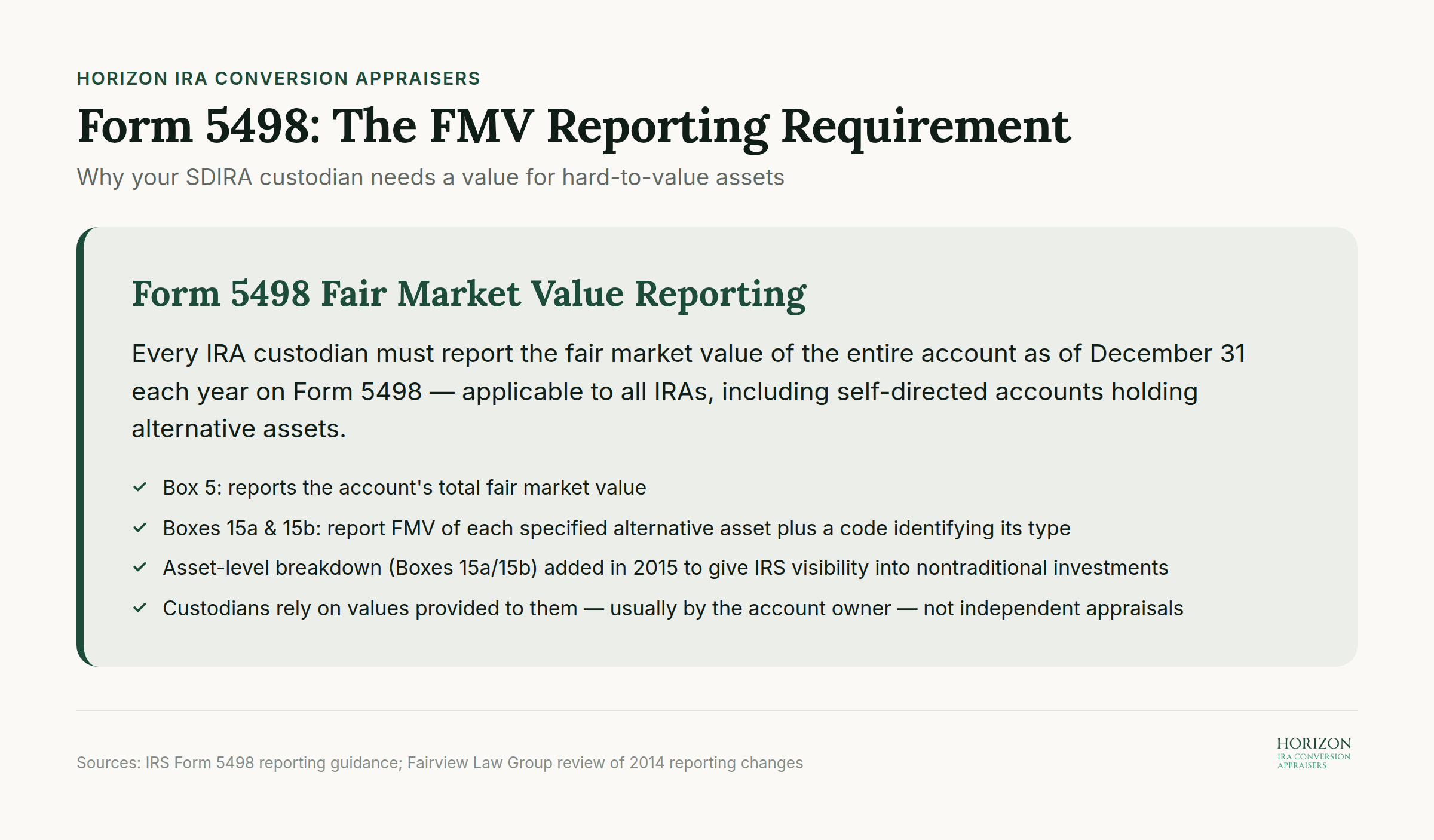
Every IRA custodian must report the fair market value of the entire account as of December 31 each year, and they do it on Form 5498. This applies to every IRA, traditional or Roth, self-directed or not, and it's not optional for accounts that hold hard-to-value property.
Box 5 on the form captures the account's total fair market value. For accounts holding one or more of the specified alternative assets described above, the custodian must also complete Boxes 15a and 15b, which report the fair market value of each specified asset alongside a code identifying its type, per the IRS's Form 5498 reporting guidance. This asset-level breakdown has been part of the form since 2015, and one legal analysis notes that the change was specifically designed to give the IRS visibility into "nontraditional" investments sitting inside self-directed accounts, per Fairview Law Group's review of the reporting changes.
The practical effect: your custodian isn't guessing at what your rental property or LLC interest is worth. They're relying entirely on a value someone else provides them, and that someone is usually you.
Who Is Actually Responsible for the Valuation?
The custodian is legally responsible for filing an accurate Form 5498, but the IRA owner is practically responsible for producing the number that goes on it. Custodians don't appraise your assets; they report the figure you or your valuation agent gives them.
This division of labor shows up consistently across custodial guidance. One custodian puts it plainly: IRA owners are "generally required to obtain valuations" of their alternative investments and hand them off for reporting, per Mainstar Trust's explanation of the valuation process. Another custodian notes that for assets like real estate or private placements, the account holder must work with a qualified third-party appraiser or valuation expert, since the custodian has no independent way to price the asset, per Horizon Trust's guidance on tax-time reporting.
Most custodians set an internal deadline, often in January, for owners to submit an updated valuation ahead of the account-level Form 5498 filing. Miss that window, and the custodian may simply carry forward last year's number, which brings its own problems.
Watch out: A stale valuation isn't a safe default. If the custodian reports last year's figure because you didn't submit anything new, that number can misstate your account's fair market value for RMD purposes and understate what the IRS sees as your true holdings.
Who Can Perform the Valuation?
The short answer is: not the IRA owner. Because the valuation directly affects tax outcomes, most custodians and industry guidance hold that the account holder cannot simply assign their own number to an asset they own inside the IRA. One custodian is explicit that "IRA owners generally may not provide their own valuation either since the valuation could affect the IRA owner's tax liability," per Mainstar Trust.
Acceptable valuation sources vary by asset type:
- Real estate: a broker's price opinion, a comparative market analysis, or a full independent appraisal, especially when the property's value has shifted meaningfully since the last filing, per StrataTrust's guidance on fair market value for alternative assets.
- Private equity and private funds: the most recent capital account statement or net asset value figure from the fund manager, per IRA Financial's overview of alternative asset valuation.
- Closely held business interests: a signed valuation from an independent, non-disqualified third party, supported by financial statements or K-1s.
- Private notes: outstanding principal plus accrued interest, supported by loan statements and payment history.
- Precious metals and cryptocurrency: straightforward market price as of December 31, since these trade on active markets, per IRA Financial's explanation of fair market value.
Our team at Horizon Business Valuations prepares independent, USPAP-compliant valuations for exactly this category of hard-to-value property, including real estate held in an IRA, closely held business interests, and private equity or LLC positions. Because our appraisers are not the account holder and hold no stake in the asset, the valuations we deliver satisfy the independence expectation custodians look for. Our credentials draw on organizations such as the American Society of Appraisers (ASA) and the National Association of Certified Valuators and Analysts (NACVA), and every report follows the Uniform Standards of Professional Appraisal Practice published by The Appraisal Foundation.
Pro tip: If you're planning a Roth conversion involving an alternative asset, get the valuation in hand well before you file. The discounted Roth IRA conversion process depends entirely on having a defensible fair market value at the moment of conversion, not a rough estimate from a few years back.
The Annual Valuation Obligation: Timing and Documentation
Fair market value must be current as of December 31 of the reporting year, not the original purchase price and not a value from several years ago. Custodians expect this figure annually, every year the asset sits in the account, regardless of whether anything changed.
Supporting documentation matters as much as the number itself. A defensible valuation package typically includes:
- A written valuation or appraisal report dated close to the December 31 measurement date.
- The methodology used, whether that's a sales comparison approach for real estate, a capital account statement for a fund interest, or an income approach for a closely held business.
- Signatures from both the IRA owner and the qualified valuator, which most custodians require on their internal FMV submission form.
- Supplemental records, such as K-1s, closing statements, financial statements, or loan payment histories, depending on the asset type.
Skipping this documentation doesn't just risk an inaccurate number. It leaves you without a paper trail if the IRS ever asks how you arrived at the figure on your account's Form 5498.
What Happens When Valuations Are Missing or Inaccurate?
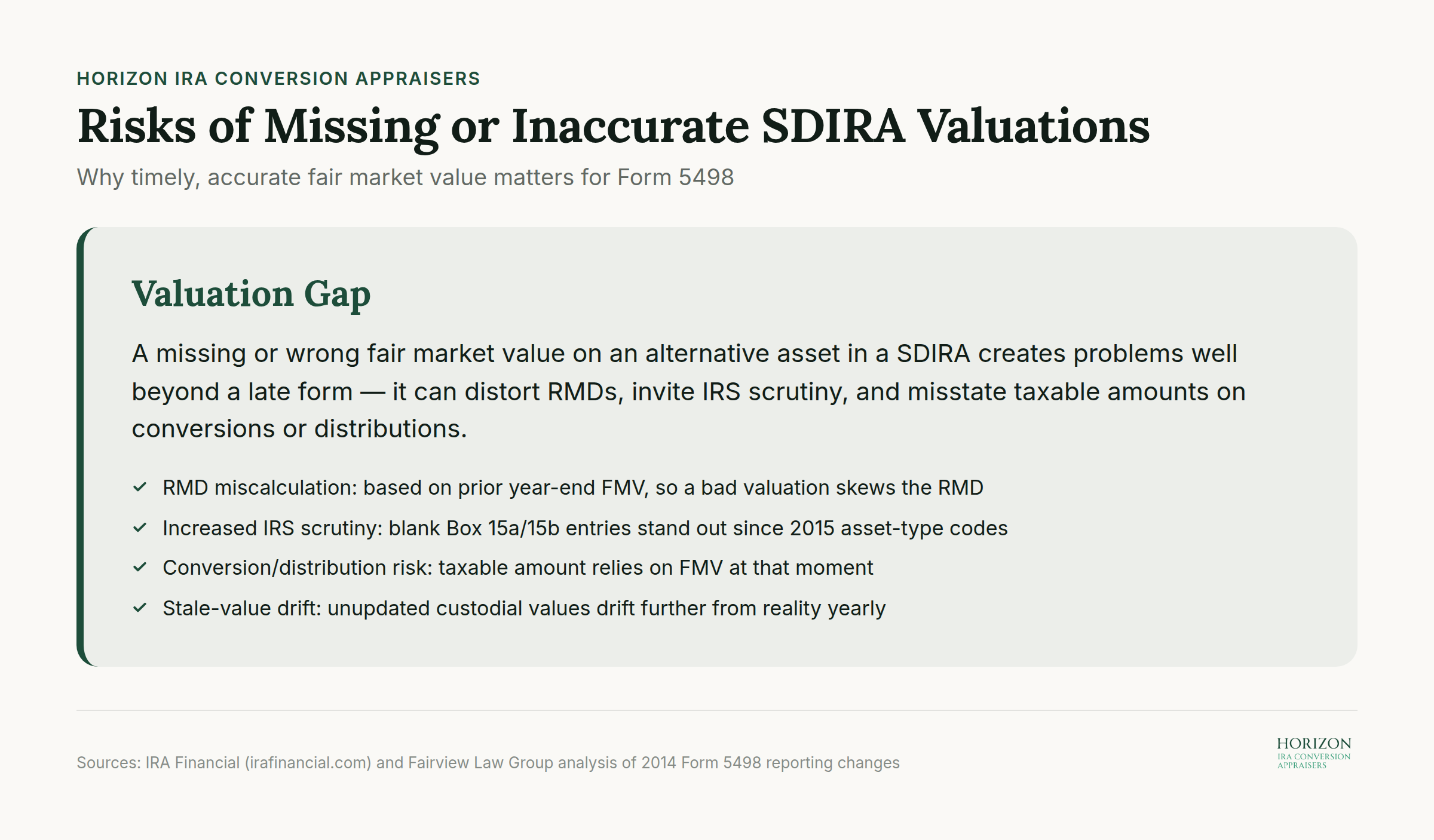
A missing or wrong valuation on an alternative asset in a SDIRA creates problems well beyond a late form. It can distort your required minimum distribution, invite IRS scrutiny, and misstate the taxable amount on a conversion or in-kind distribution.
RMD miscalculation. Your required minimum distribution is calculated from the prior year-end fair market value of the account. If that figure is understated because a valuation was never submitted, your RMD calculation will be wrong too, which creates its own downstream compliance issue for the account holder, per IRA Financial's explanation of fair market value in a self-directed IRA.
Increased IRS scrutiny. The 2015 addition of asset-type codes to Form 5498 gave the IRS a direct window into which accounts hold nontraditional investments. Blank or inconsistent entries in Boxes 15a and 15b stand out precisely because they're now a standard reporting field, not an afterthought, per Fairview Law Group's analysis of the reporting changes.
Conversion and distribution risk. Any time an asset moves out of the IRA, whether through an in-kind distribution or a Roth conversion, the taxable amount is based on fair market value at that moment. An unsupported or outdated number invites the IRS to challenge the reported income, and that challenge lands on the account holder, not the custodian.
Stale-value drift. When an owner doesn't submit an update, the custodian typically reports the most recent value on file. Over several years, that stale figure can drift further and further from reality, compounding the RMD and reporting problems above.
Prohibited Transactions and Self-Dealing Risk
Valuation problems for alternative assets in a SDIRA often intersect with a separate, more serious risk: prohibited transactions. Under IRC Section 4975, an IRA owner cannot use IRA-owned property for personal benefit, cannot buy or sell assets between the IRA and themselves or certain family members, and cannot direct the IRA to transact with a business they or a disqualified relative control.
Valuation ties into this risk in a direct way. If the IRA owner supplies their own valuation for an asset (which most custodians already prohibit) and that number is used to structure a transaction that quietly benefits the owner, such as an undervalued in-kind distribution, it can support a prohibited transaction finding. A prohibited transaction of this kind can cause the entire IRA to be treated as distributed as of January 1 of that year, with tax due on the full account value, an outcome far more costly than a routine valuation update.
This is exactly why independence matters. A qualified, unrelated third-party appraiser removes the incentive problem and gives the custodian, and the IRS, a number that wasn't produced by the person who stands to benefit from it.
How We Value Alternative Assets Held in a SDIRA
Our appraisers at Horizon Business Valuations work specifically with account holders and custodians on the hard-to-value assets that show up in Boxes 15a and 15b of Form 5498: rental and commercial real estate, private equity and LLC positions, closely held business interests, and private notes. Each report is prepared in accordance with USPAP and documents the methodology, comparable data, and conclusion an IRS examiner or custodian would expect to see.
If you're weighing a Roth conversion involving one of these assets, understanding the valuation discount landscape matters just as much as the base figure. Our guide on discounted Roth IRA conversions walks through how minority and marketability discounts affect the taxable amount, and our private stock appraisal guide covers the specific documentation needed for non-traded equity positions.
Frequently Asked Questions
Q: Does every self-directed IRA need an annual appraisal, even if nothing changed? Yes, if the account holds an asset without a readily available market value. Custodians need a current fair market value as of December 31 every year to complete Form 5498, regardless of whether the underlying asset changed hands or not.
Q: Can I use last year's appraisal to save money? Not reliably. Custodians may accept it as a stopgap, but an outdated figure can misstate your RMD and won't hold up well if the IRS asks how the current year's value was determined. A short, updated valuation is usually far less costly than the compliance risk of a stale one.
Q: What if my alternative asset lost significant value this year? Report the current, lower fair market value. Understating losses to avoid the appearance of a bad investment creates the same reporting and RMD problems as overstating a gain, and it doesn't reduce your tax exposure in any way that benefits you.
Q: Who fills out Box 15a and 15b on Form 5498? The custodian completes the form, but they rely entirely on the fair market value figure and asset type you or your valuation provider supply. If you don't submit one, the custodian cannot generate it independently.
Get an Independent Valuation Before Your Next Filing
Alternative assets in a SDIRA carry real reporting obligations, and the account holder, not the custodian, is the one who has to make sure the number is right. An independent, well-documented appraisal protects your RMD calculation, keeps your Form 5498 filing clean, and gives you a defensible record if the IRS ever asks questions. If you hold real estate, a closely held business interest, or another hard-to-value asset in your SDIRA, request an appraisal from our team and get a USPAP-compliant valuation before your next filing deadline.
This article is provided for general informational purposes only and does not constitute legal, tax, or financial advice. Readers should consult a qualified attorney or CPA regarding their specific circumstances.