Blog
Top Self-Directed IRA Custodians: How to Choose and What Each One Offers
Comparing self-directed IRA custodians means weighing asset-type support, fee transparency, and account minimums, not just marketing claims. This guide breaks down five widely used custodians platform by platform and explains why an independent appraisal still matters for the hard-to-value assets they hold.
Picking a self-directed IRA custodian is a different exercise than picking a brokerage for a traditional IRA. The custodian you choose determines which asset classes you can actually hold, how transactions get processed, and what you'll pay in ongoing fees. It does not determine whether any single investment is sound, properly valued, or even legitimate. This guide walks through how to evaluate a custodian, compares five widely used providers, and explains why a defensible appraisal still falls on you, not the custodian, once a hard-to-value asset sits inside the account. For background on how these accounts work at all, see our full guide to how self-directed IRAs work.
How to Evaluate a Self-Directed IRA Custodian
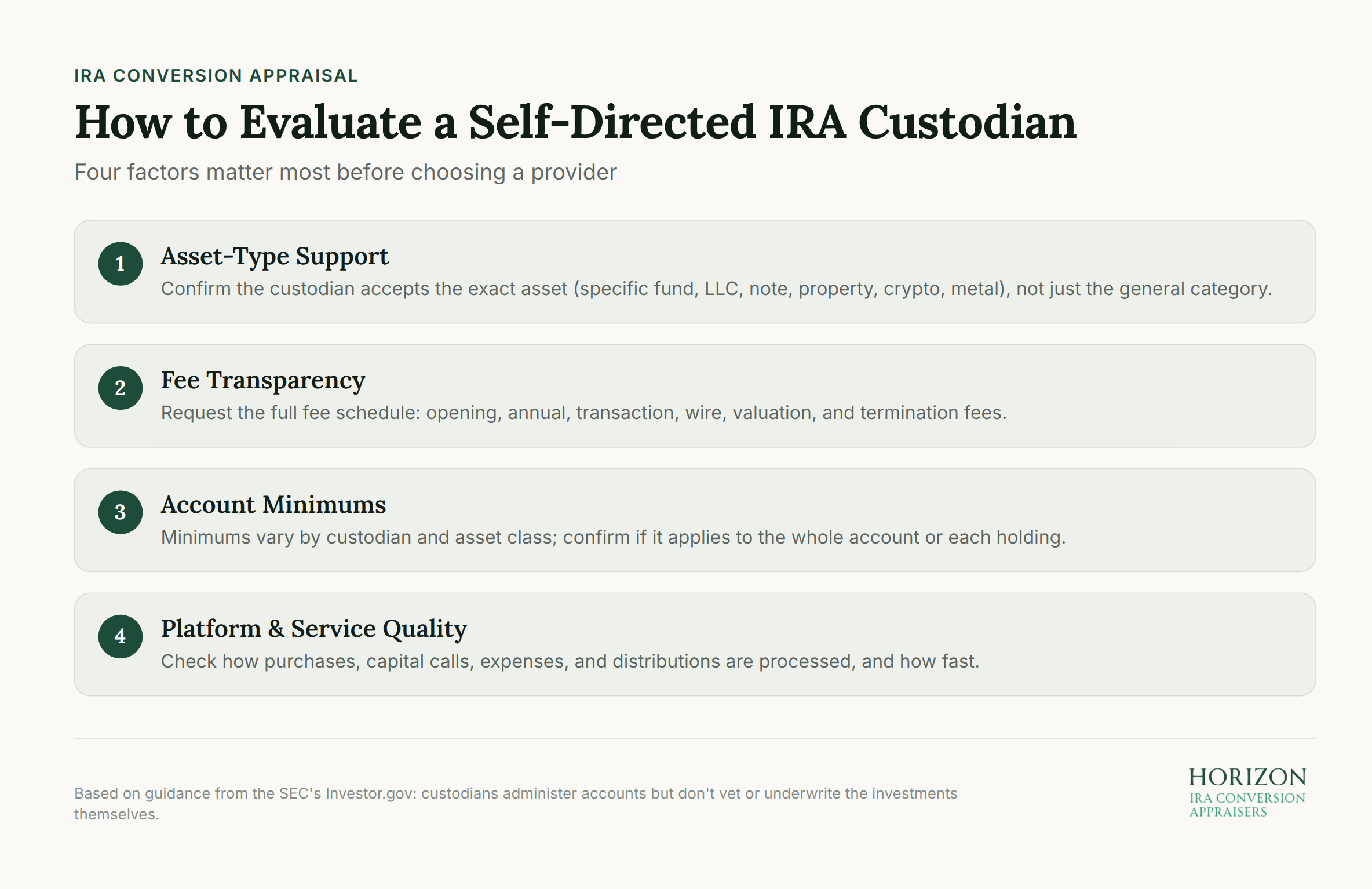
The right custodian is the one whose asset menu, fee structure, account minimums, and service quality actually match the investment you intend to hold, not the one with the flashiest marketing. Four factors matter most.
- Asset-type support: Confirm the custodian accepts the exact asset you want, such as a specific private fund, LLC interest, promissory note, property type, cryptocurrency, or metal, not just the general category. A custodian that lists "private equity" as an accepted asset class may still decline a specific fund structure.
- Fee transparency: Request the full published fee schedule, including account-opening, annual, transaction, wire, valuation, and termination fees. A low headline fee can be offset by per-transaction or asset-specific charges that only show up once you're invested.
- Account minimums: Minimums vary widely by custodian and sometimes by asset class within the same custodian. Confirm the minimum applies to the account as a whole or to each individual holding.
- Platform and service quality: Consider how purchase instructions, capital calls, property expenses, and distributions actually get processed, and how quickly. A custodian with a clunky paper-based process can slow down a time-sensitive transaction, such as a real estate closing.
The SEC's Investor.gov warns that SDIRA custodians generally administer the account rather than underwrite or vet the investment itself. They typically do not investigate the asset, confirm a sponsor's claims, or evaluate whether an investment is suitable for you. That division of labor is the single most important thing to understand before comparing providers: a custodian can offer access to an asset class without ever independently checking the asset's quality, valuation, or legitimacy.
Top Self-Directed IRA Custodians at a Glance
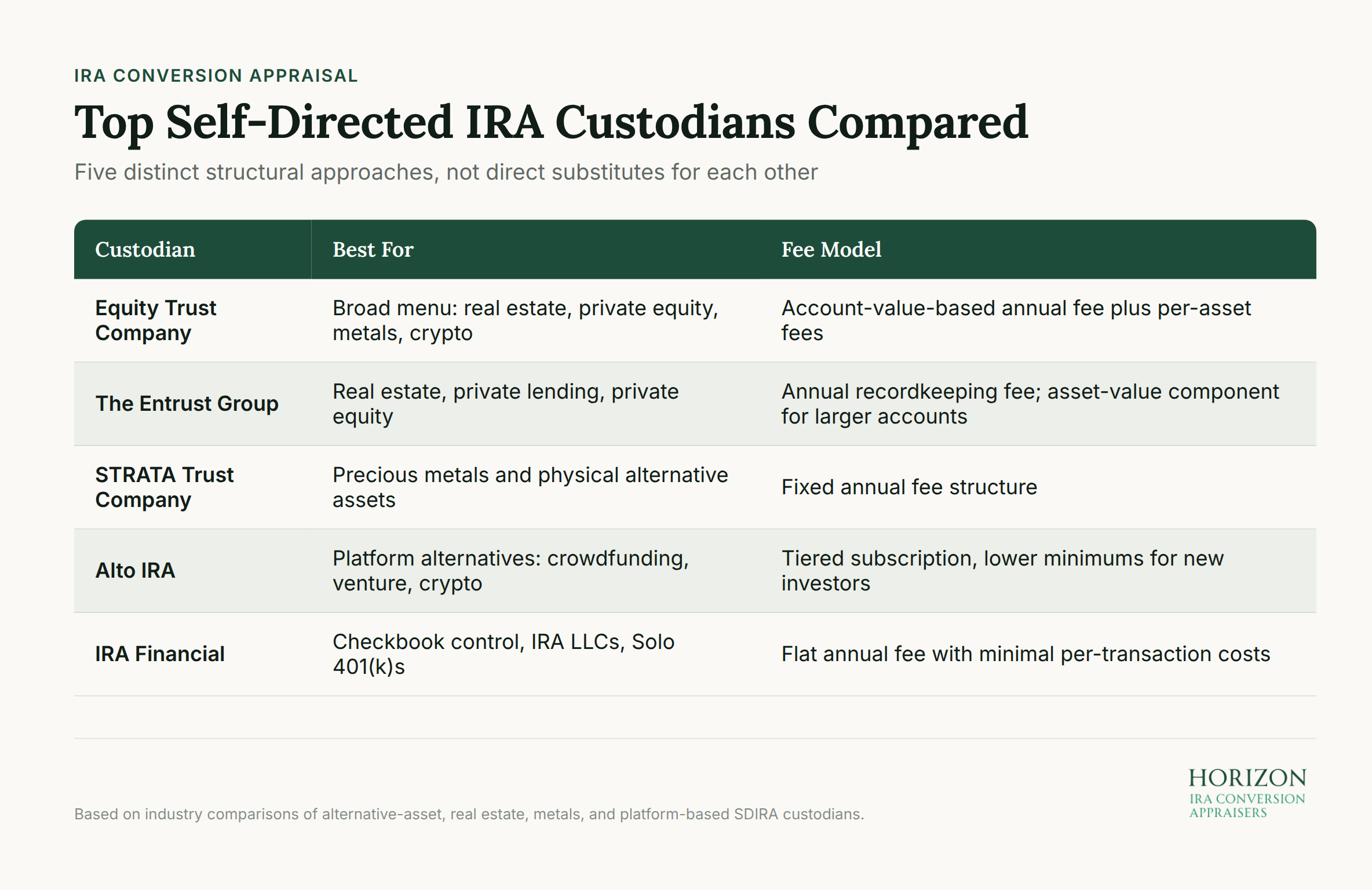
Industry comparisons commonly reference a mix of broad alternative-asset custodians, real-estate specialists, metals-focused custodians, and technology-first platforms, and rankings differ depending on which asset class a given publication emphasizes. The five custodians below turn up repeatedly across independent comparisons and represent distinct structural approaches rather than direct substitutes for each other.
| Custodian | Best For | Fee Model |
|---|---|---|
| Equity Trust Company | Broad alternative asset menu: real estate, private equity, precious metals, crypto | Account-value-based annual fee plus per-asset fees |
| The Entrust Group | Real estate, private lending, private equity | Annual recordkeeping fee with an asset-value component for larger accounts |
| STRATA Trust Company | Precious metals and physical alternative assets | Fixed annual fee structure |
| Alto IRA | Platform-based alternatives: crowdfunding, venture, crypto | Tiered subscription, lower minimums for newer investors |
| IRA Financial | Checkbook control structures, IRA LLCs, Solo 401(k)s | Flat annual fee with minimal per-transaction costs |
Equity Trust Company
Equity Trust is one of the longer-established custodians in this space and is typically singled out for the sheer breadth of its accepted asset menu. An investor who wants a single account capable of holding real estate, private equity interests, precious metals, and digital assets, rather than splitting those holdings across several specialized custodians, tends to fit this model best. Confirm current fee tiers, per-asset charges, and minimums directly on the custodian's site before funding an account, since schedules change and vary by asset type.
The Entrust Group
Entrust has a long track record with real estate investors specifically, including direct property, private lending, and syndicated deals. Its administrative processes are built around the mechanics of property ownership inside an IRA: earnest money, rental income, expense payments, and the documentation a lender or title company expects to see. Investors building a real-estate-heavy portfolio inside a retirement account are the clearest fit. As with any custodian, verify the current recordkeeping fee and any asset-value-based component before opening an account.
STRATA Trust Company
STRATA Trust is frequently cited for its focus on precious metals and other physical, tangible alternative assets. It coordinates with depositories for storage and insurance arrangements, which matters because IRS rules on collectibles under the tax code require specific custody arrangements for IRA-held bullion and coins rather than personal possession. Investors prioritizing metals holdings, sometimes alongside other physical assets, are the natural audience here. Confirm the current annual fee and any separate storage or insurance charges directly with the custodian.
Alto IRA
Alto represents the newer, technology-first end of the custodian landscape. It integrates with crowdfunding platforms, venture investment marketplaces, and select cryptocurrency exchanges, and is generally built around a self-service online experience rather than paper-based processing. Investors who want lower account minimums to get started, and who are comfortable managing transactions through a digital interface, tend to gravitate here. Subscription tiers and supported integrations change over time, so confirm the current menu and pricing on the platform itself.
IRA Financial
IRA Financial specializes in checkbook control structures: an IRA-owned LLC (or a Solo 401(k) for self-employed individuals) that lets the account owner transact directly without routing every purchase through the custodian for approval. That structure appeals to investors who want speed and direct control, but it also shifts more of the prohibited-transaction compliance burden onto the owner, since there is no custodian sign-off acting as a checkpoint before each transaction. Review the flat annual fee and any per-transaction costs, and understand the LLC structure's legal and tax implications, before committing.
Watch out: None of these descriptions are endorsements, and we have no affiliation with any of the five custodians named here. Fee schedules, asset menus, and account minimums change, and the only reliable source for current terms is each custodian's own site. Treat any older article's dollar figures, including ours, as a starting point for questions rather than a quote.
Why Custodians Don't Validate Fair Market Value
A custodian's job is administration, not valuation, and that gap becomes a real compliance issue the moment you convert, distribute, or report a hard-to-value asset. The IRS's prohibited transaction guidance makes clear that the account owner, not the custodian, bears responsibility for avoiding transactions that benefit a disqualified person, and the Government Accountability Office has reported that unconventional-asset IRAs create ongoing compliance and enforcement challenges precisely because valuation and oversight are thinner than in a standard brokerage IRA.
In practice, this means the custodian will record whatever value it is given for a hard-to-value asset, whether that number comes from the sponsor, the owner, or a qualified third party. It will not independently confirm that the number reflects fair market value. That responsibility sits with you.
Where an Independent Appraisal Comes In
Three events specifically require a defensible fair market value for a hard-to-value SDIRA asset, regardless of which custodian holds the account.
- Roth conversions: Converting a traditional IRA asset to a Roth IRA triggers ordinary income tax on the asset's fair market value at the time of conversion, as described in the IRS guidance on Roth IRA distributions and conversions. An inflated or unsupported number overstates the tax bill; an understated number invites scrutiny.
- In-kind distributions: Taking a hard-to-value asset out of an IRA as a distribution, rather than as cash, similarly requires a supportable fair market value at the date of distribution under the IRS rules governing traditional IRA distributions.
- Annual Form 5498 reporting: Custodians report the account's fair market value each year on Form 5498, including box 5 for the general account value and boxes 15a and 15b specifically for hard-to-value assets. The IRS Instructions for Forms 1099-R and 5498 require the custodian to obtain that valuation, but they do not require the custodian to produce it independently; the burden of providing a supportable number still falls to the account owner. For more on how that reporting requirement works in practice, see our guide to Form 5498 fair market value rules for self-directed IRA Roth conversions.
This is where our team comes in. We prepare USPAP-compliant fair market value appraisals for the alternative assets held inside self-directed IRAs, whatever custodian administers the account, so the number reported on Form 5498 and the number used at conversion or distribution can withstand review. Choosing the right custodian is step one. Getting the valuation right at each taxable event is the step that keeps the account defensible.
If you're planning a Roth conversion, an in-kind distribution, or need an annual valuation for a hard-to-value SDIRA asset, request an appraisal and our team will scope the engagement for your specific asset type.
This article is provided for general informational purposes only and does not constitute legal, tax, or financial advice. Readers should consult a qualified attorney or CPA regarding their specific circumstances.