Blog
Should You Convert a Self-Directed IRA to a Roth Before or After Retirement?
Converting a self-directed IRA's hard-to-value assets to a Roth isn't a single decision but a multi-year sequencing question, and the appraisal date drives the entire tax bill. This guide walks through the pre-retirement versus trough-years tradeoff and why the valuation has to come before the decision, not after.
Converting a self-directed IRA (SDIRA) to a Roth looks simple on paper: pick a year, pay tax on the converted amount, and never pay tax on that money again. The complication shows up when the account holds real estate, a private business interest, precious metals, or a promissory note instead of cash or publicly traded stock. For those assets, the taxable amount isn't a bank statement figure. It's whatever a qualified appraisal says the asset was worth on the conversion date, and that number changes the math enough to make timing a genuine strategic decision rather than a one-time event.
This guide walks through why the IRS anchors the tax bill to a specific valuation date, how the pre-retirement versus post-retirement tradeoff actually plays out for illiquid assets, and why getting the appraisal done before you decide to convert, not after, is the only way to know what you're really signing up for.
Why the IRS Requires Fair Market Value as of the Conversion Date
A Roth conversion is taxed as ordinary income in the year it happens, and for a self-directed IRA holding an alternative asset, that income figure is set by the asset's fair market value on the date of conversion. The IRS Publication 590-A guidance on IRA distributions and conversions treats the converted amount the same way regardless of asset type: whatever value transfers out of the traditional IRA and into the Roth is the amount included in gross income that year.
Your custodian reports that value on Form 5498 for the receiving Roth account, and the distribution side shows up on a 1099-R. For cash or a brokerage account full of mutual funds, that number is self-evident. For a rental property, an LLC interest, or a stake in a pre-IPO company, there's no ticker price to pull. Someone has to determine it, and the IRS doesn't accept a guess or a round number pulled from the original purchase price. The valuation has to be defensible enough to survive scrutiny, which is why custodians and tax preparers increasingly require a USPAP-compliant appraisal before they'll process the paperwork.
Key takeaway: the dollar amount you owe tax on isn't the asset's purchase price or its value when you funded the IRA years ago. It's the appraised value on the day the conversion happens, and that figure is the one number the entire decision hinges on.
The Core Tradeoff: Convert Before Retirement or Wait for the Trough Years
There's no special tax rule that rewards converting before or after you stop working. The law treats the conversion the same way either time; what changes is your marginal tax rate and, for an illiquid asset, the value the appraiser arrives at on that date.
Converting while still earning a salary usually means stacking the converted amount on top of wages that already fill the lower tax brackets, which can push a meaningful share of the conversion into the 24%, 32%, or higher federal brackets. Waiting until after you've stopped working but before required minimum distributions (RMDs) begin opens what financial planners sometimes call the retirement income valley, a stretch of years where earned income has dropped but RMDs haven't started yet. Fidelity's planning guidance specifically points to this window as a common opportunity for partial conversions at a lower marginal rate.
But for an SDIRA holding a hard-to-value asset, waiting carries a cost that a cash conversion doesn't: the asset may have appreciated while you waited, and that appreciation flows straight into a larger taxable conversion amount. A rental property purchased by the IRA five years ago at $300,000 might appraise for $420,000 today. Converting it now, even at a lower marginal rate, could still produce a bigger tax bill than converting it earlier at a lower appraised value and a higher bracket.
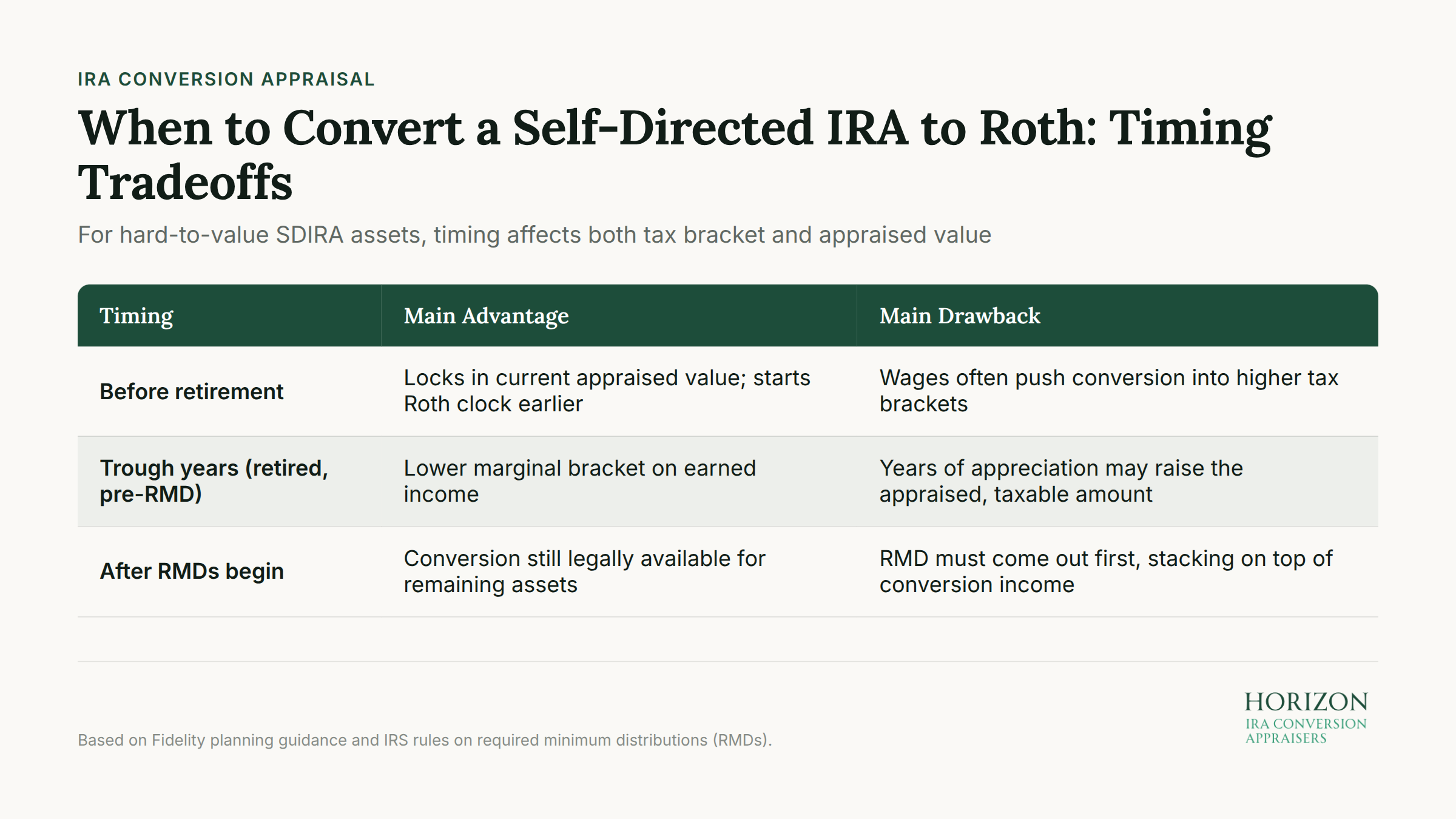
| Timing | Main advantage | Main drawback |
|---|---|---|
| Before retirement | Locks in the current appraised value; starts the Roth clock earlier | Wages often push the conversion into higher brackets |
| Trough years (retired, pre-RMD) | Lower marginal bracket on earned income | Years of appreciation may raise the appraised, taxable amount |
| After RMDs begin | Conversion is still legally available for remaining assets | The RMD must come out first, stacking on top of the conversion income |
The IRS rules on required minimum distributions confirm that once RMDs start, generally at age 73 or 75 depending on birth year, the RMD amount itself cannot be converted; it has to come out first, and only additional assets beyond the RMD are eligible for conversion.
Why Hard-to-Value Assets Complicate This Differently Than Cash
Converting a brokerage account is almost frictionless. You can convert exactly $40,000 of a $500,000 account and leave the rest in the traditional IRA, adjusting the amount in real time as you watch your tax bracket. An illiquid SDIRA asset doesn't allow that kind of precision.
A building, a private company interest, or a block of precious metals generally has to be converted as a whole unit, or divided in ways that require their own appraisal support (a fractional interest discount, for example). You can't convert "60% of the warehouse" without an appraiser and, often, a formal analysis of lack of control and lack of marketability discounts if the conversion involves a partial ownership stake. That means the staged, incremental conversion strategy that works well for a stock portfolio has to be engineered around the asset's actual divisibility and appraised value, not around a tax-bracket target alone.
It also means the appraisal itself, not just the dollar figure it produces, becomes part of the compliance record. An unsupported or informal valuation can draw the same scrutiny as underreporting income, because the IRS treats the appraised value as the basis for the tax owed on the conversion.
Secondary Effects That Show Up One or Two Years Later
A large conversion year doesn't just affect that year's tax return. Two downstream effects catch people off guard because they land in a later tax year, after the conversion decision is already locked in.
- Medicare IRMAA surcharges: Medicare Part B and Part D premiums are income-adjusted based on modified adjusted gross income from two years prior. A large Roth conversion this year can trigger a higher Medicare premium bracket two years from now, even if your income returns to normal immediately afterward.
- Social Security provisional income thresholds: if you're already collecting Social Security, a conversion year's added income can push more of your benefit into taxable territory, since the taxable portion of Social Security is determined by a provisional income calculation that includes other taxable income like a Roth conversion.
Neither of these appears on the conversion paperwork itself. Both are reasons to model the conversion's effect across a two-to-three-year window rather than evaluating a single tax return in isolation.
RMD Sequencing: You Can't Skip This Step
If you're already subject to required minimum distributions, the RMD has to be satisfied before any additional conversion happens in that tax year. The IRS FAQ guidance on IRA required minimum distributions is explicit that the RMD is not eligible for rollover or conversion treatment; the first dollars distributed in a given year are treated as satisfying that year's RMD before anything else counts toward a Roth conversion.
For an SDIRA, this creates a practical wrinkle: if the RMD is calculated against an illiquid asset's appraised value and the custodian needs cash to distribute, you may need a current appraisal just to calculate the RMD correctly, separate from any appraisal tied to a subsequent conversion decision.
Watch out: converting before taking that year's RMD is a common sequencing mistake. The IRS doesn't allow the converted amount to double as the RMD, so doing it in the wrong order can leave the RMD requirement unsatisfied even after a conversion has taken place.
A Sequencing Framework: Appraise First, Decide Second
The decision between converting before or after retirement isn't really a before-or-after question. It's a multi-year planning exercise, and it starts with knowing the number, not guessing at it.
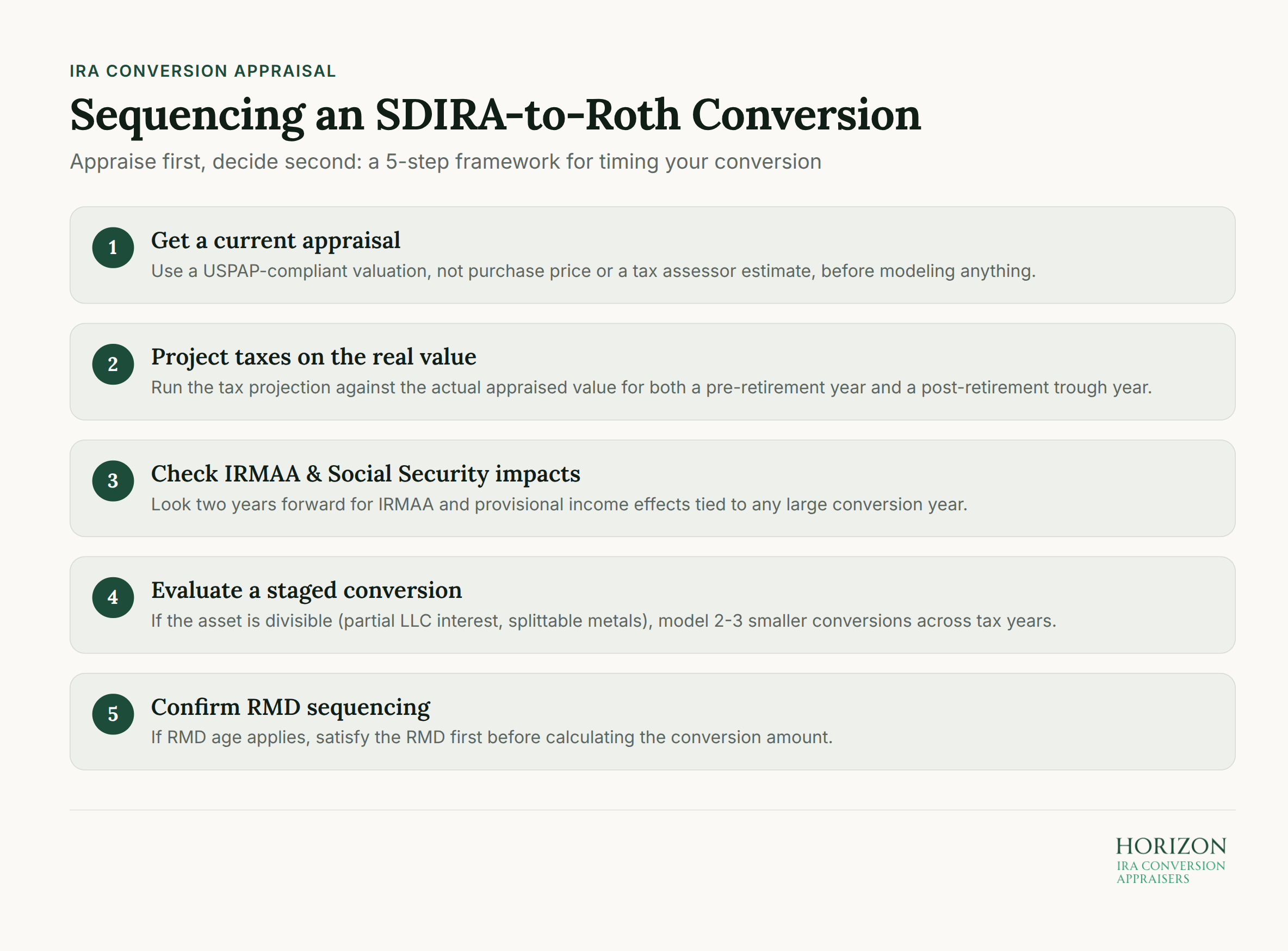
- Get the asset appraised before modeling the conversion. An estimate based on the original purchase price, a tax assessor's figure, or a rough market comparison isn't a substitute for a current, USPAP-compliant valuation. Without it, every tax projection downstream is built on a guess.
- Run the tax projection against the actual appraised value, not a placeholder number, across both a pre-retirement year and a post-retirement trough year.
- Check for IRMAA and Social Security provisional income effects two years forward from any year you're considering for a large conversion.
- Evaluate whether a staged conversion is possible. If the asset can be fractionally converted (a partial LLC interest, a divisible metals holding), model two or three smaller conversions across different tax years instead of one large event.
- Confirm RMD sequencing if you're at or past the age where RMDs apply, so the RMD is satisfied before any conversion amount is calculated.
What This Means for Your Appraisal Costs
Appraisal fees for an SDIRA conversion are quoted as a fixed fee after we scope the assignment, never billed hourly, and the fee is driven by the complexity of the asset and the depth of analysis required, not by the asset's market value or how the conversion affects your taxes. For a closely held business interest or LLC held inside an SDIRA, a standard business valuation typically starts at $4,500, with an IRS-qualified valuation starting at $5,500 and more complex engagements (multiple entities, disputed value, or layered ownership structures) typically running $7,500 to $12,000 or more. For other asset types inside an SDIRA, including real estate, precious metals, or private notes, the fee is quoted as a fixed amount once we understand the specific asset, the records available, and whether the report needs to meet IRS-qualified standards.
The appraisal cost for a self-directed IRA Roth conversion is almost always smaller than the swing in tax liability that an accurate, defensible valuation can produce, particularly when the alternative is relying on an outdated or informal estimate that invites IRS scrutiny later.
Deciding With the Actual Numbers in Hand
There's no universal answer to whether converting before or after retirement is better. The right year depends on your marginal bracket, how much the asset has moved since you last had it valued, whether RMDs are already in play, and how a large conversion year will ripple into Medicare premiums and Social Security taxation two years later. What's consistent across every scenario is that the decision should follow the appraisal, not precede it. Our appraisers prepare USPAP-compliant valuations for SDIRA assets so you can model the real tax consequence of a conversion before you commit to a year, rather than finding out the number after the paperwork is filed. If you're weighing conversion timing on a self-directed IRA holding real estate, a business interest, or another hard-to-value asset, request an appraisal to get the current fair market value before you decide.
This article is provided for general informational purposes only and does not constitute legal, tax, or financial advice. Readers should consult a qualified attorney or CPA regarding their specific circumstances.