
Blog
How Lack of Marketability and Minority Interest Discounts Affect SDIRA Roth Conversions
A Roth conversion of self-directed IRA assets is taxed on fair market value, and a properly supported discount for lack of marketability or minority interest can lower that value and your tax bill. This guide explains how the discounts work, what a defensible appraisal must include, and who actually performs this valuation work.
If your accountant flagged a possible "discount" on your self-directed IRA assets before a Roth conversion, they are pointing to a real and well-established concept in valuation practice, not a loophole. The short answer: when a self-directed IRA (SDIRA) holds an LLC membership interest, closely held business stock, or a fractional interest in real estate, the fair market value used for your Roth conversion can legitimately reflect a discount for lack of marketability and, where applicable, a discount for lack of control (minority interest). Both discounts have to come from a qualified, independent appraisal, not a guess or a rule-of-thumb percentage pulled from an article.
Why a Roth Conversion of SDIRA Assets Requires an Independent Appraisal
A Roth conversion is treated as a taxable distribution from your traditional IRA, valued at fair market value on the date of conversion. The IRS FAQs on IRA rules and IRS Publication 590-A both describe conversions this way: the amount you owe tax on is the fair market value of what left the traditional IRA and entered the Roth account, not its original purchase price or your account statement balance.
That matters enormously for SDIRA holders, because most self-directed accounts hold assets with no public quote. There is no ticker price for an LLC membership interest or a one-third undivided interest in a rental property. Someone has to determine what that interest is actually worth to a hypothetical buyer, and that determination flows directly into your tax return.
Your custodian reports the conversion and year-end account value on Form 5498, and you report the taxable conversion amount on Form 8606. Neither form is where the valuation happens. The custodian is not in the business of appraising your LLC interest, and the IRS does not expect them to be. The fair market value that ends up on those forms has to originate from a credible, independent valuation, prepared before the conversion is finalized. Rev. Proc. 2006-13 reflects the same underlying principle that non-publicly traded interests require a documented, methodical approach to value rather than an assumed figure.
Watch out: Custodians will often accept whatever value you or your CPA submit for reporting purposes. That does not make the number defensible. If the IRS later examines the conversion, the burden falls on you to show how the reported value was determined.
What Is a Valuation Discount, and Why Does It Apply to SDIRA Assets?
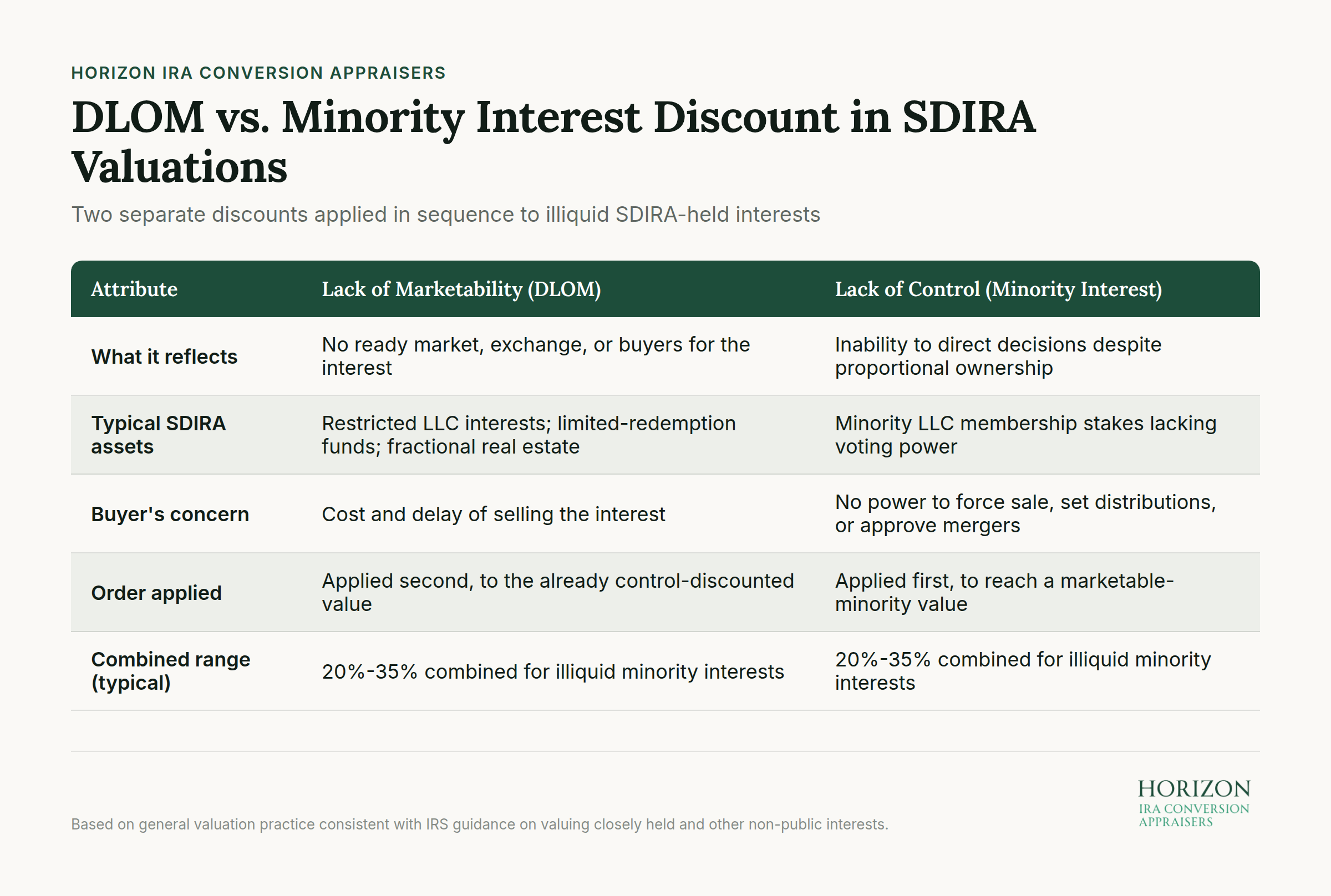
A valuation discount is a reduction applied to a pro-rata share of an asset's underlying value to reflect real economic disadvantages that a buyer would price into the deal. Two distinct discounts commonly apply to SDIRA-held assets: the discount for lack of marketability (DLOM) and the discount for lack of control, also called a minority interest discount.
Discount for lack of marketability (DLOM) reflects the simple fact that an interest with no ready market, no exchange, no line of buyers, is worth less than an identical interest that can be sold quickly and cheaply. An LLC membership interest with transfer restrictions, a private fund position with limited redemption rights, or a fractional real estate interest that requires partition proceedings to unwind all carry this kind of illiquidity cost. General valuation practice, consistent with the IRS's own discussion of valuing closely held and other non-public interests, recognizes that this illiquidity has a real, quantifiable price.
Discount for lack of control (minority interest discount) reflects the difference between owning enough of an entity to direct its decisions and owning a slice you cannot leverage. A minority LLC member cannot force a sale, set distribution policy, or approve a merger. That absence of control is worth less to a buyer than a controlling stake would be, even if the two interests represent the same proportional share of underlying net asset value.
These two discounts are conceptually separate and are typically applied in sequence: the lack-of-control discount is applied first to arrive at a marketable-minority value, and the lack-of-marketability discount is applied second to that already-discounted figure. Courts and tax authorities have historically accepted combined discounts in a wide range, commonly landing somewhere between 20% and 35% for illiquid minority interests, though the correct number in any specific case depends entirely on the facts: the entity's governing documents, its distribution history, transfer restrictions, and the specific market for interests like it.
How These Discounts Affect the Taxable Amount of Your Roth Conversion
A lower, properly supported fair market value means a smaller amount reported as converted, and a smaller current-year tax bill. This is the mechanical reason your CPA raised the topic: the discount is not a tax dodge, it is an accurate reflection of what your specific interest is worth, and accuracy happens to work in your favor here.
Pro tip: The discount has to be supported by an independent appraiser applying recognized methodology, not selected because it produces a preferred tax outcome. Appraisers document holding restrictions, distribution history, transfer rights, and comparable transaction or restricted-stock data to justify the specific percentage used.
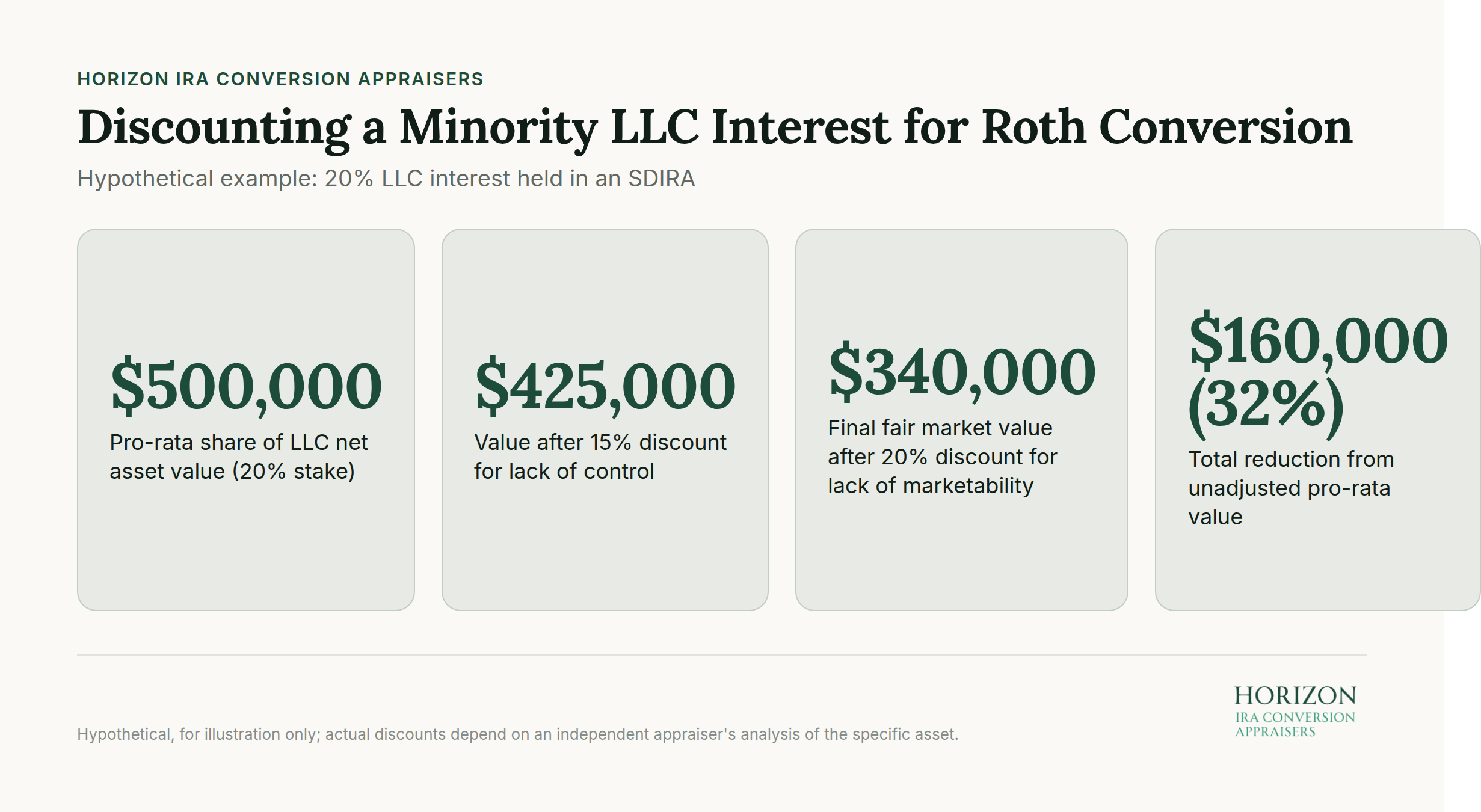
Example (hypothetical, for illustration only): Say your SDIRA holds a 20% membership interest in an LLC that owns a portfolio of rental properties. Your pro-rata share of the LLC's net asset value, calculated by simply multiplying 20% by the entity's total equity, comes to $500,000. But your interest is a minority position with no voting control, and the operating agreement restricts transfers without unanimous member consent.
An independent appraiser applies a 15% discount for lack of control to reflect your inability to direct the entity's decisions, bringing the marketable-minority value to $425,000. The appraiser then applies a 20% discount for lack of marketability to reflect the illiquidity and transfer restrictions, bringing the final fair market value to $340,000.
| Step | Value |
|---|---|
| Pro-rata share of LLC net asset value | $500,000 |
| After 15% discount for lack of control | $425,000 |
| After 20% discount for lack of marketability | $340,000 |
| Reduction from unadjusted pro-rata value | $160,000 (32%) |
If you are in a 32% marginal tax bracket, that $160,000 reduction in reportable conversion value corresponds to roughly $51,200 less in federal tax owed for the conversion year, assuming no other factors change. These numbers are illustrative only. Your actual discount percentages, and the resulting tax effect, depend entirely on your specific asset, its governing documents, and a qualified appraiser's independent analysis.
What a USPAP-Compliant Appraisal for This Purpose Includes
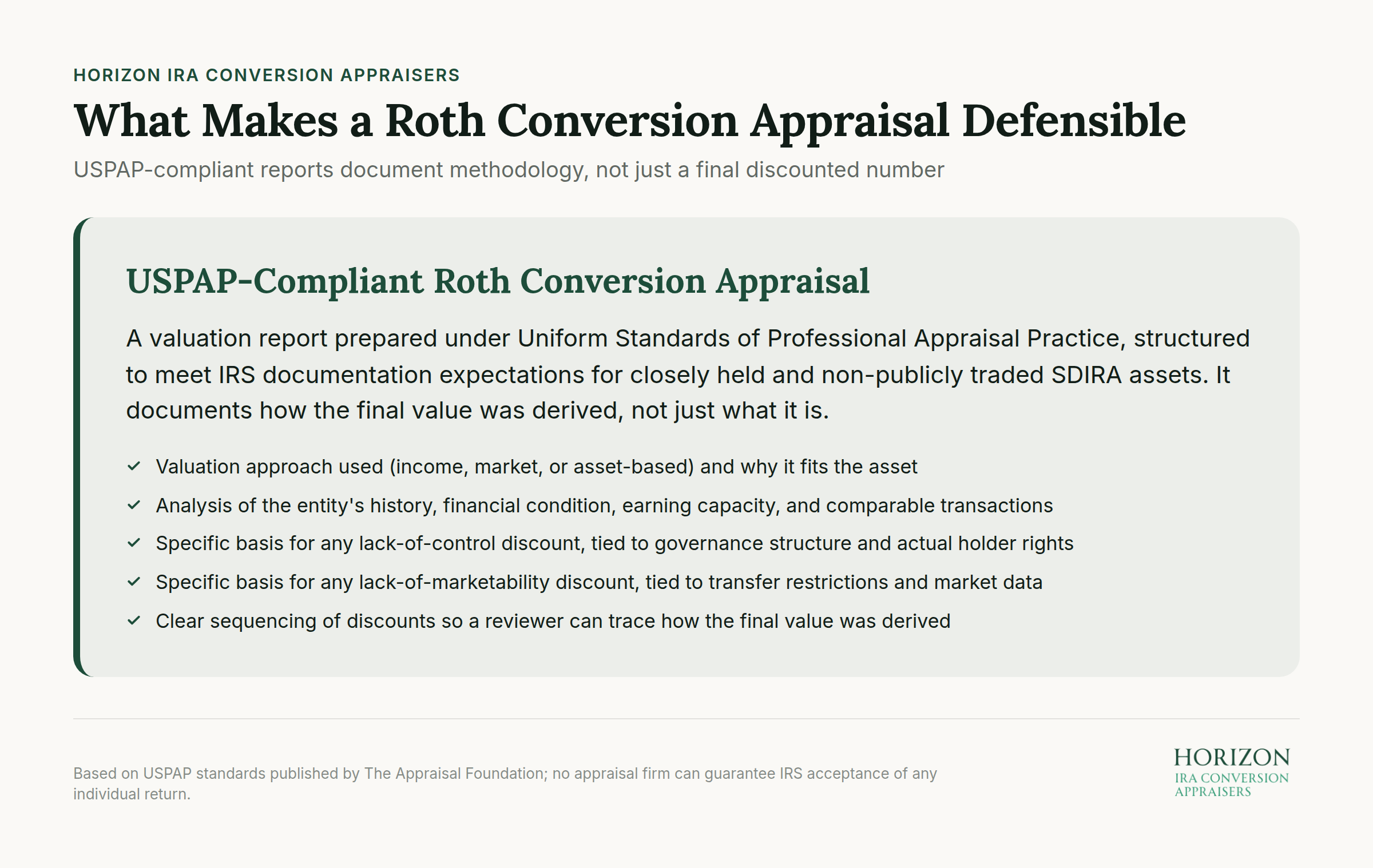
A defensible Roth conversion appraisal is prepared in accordance with the Uniform Standards of Professional Appraisal Practice (USPAP), published by The Appraisal Foundation, and structured to meet IRS documentation expectations for closely held and non-publicly traded interests. That means the report does more than state a final number.
A properly built report typically documents:
- The valuation approach used (income, market, or asset-based), and why it fits the specific asset
- An analysis consistent with the factors long applied by the IRS to closely held interests: the entity's history, financial condition, earning capacity, and comparable transaction data
- The specific basis for any discount for lack of control, including the entity's governance structure and the interest holder's actual rights
- The specific basis for any discount for lack of marketability, including transfer restrictions, holding period expectations, and relevant market or restricted-interest data
- The sequencing of discounts applied, so a reviewer can see exactly how the final value was derived
This level of documentation matters most if the conversion is later examined. There is no way to guarantee how the IRS will treat any individual return, and no appraisal firm can promise IRS acceptance. What a properly prepared, USPAP-compliant report does is give you and your CPA a defensible position: a documented methodology, supported by data specific to your asset, rather than an assumed percentage.
Key takeaway: The strength of a Roth conversion valuation is not the size of the discount. It is how well that discount is supported if someone ever asks you to explain it.
We Prepare These Appraisals Directly, We Do Not Refer You Elsewhere
If you are looking for a firm to appraise your SDIRA-held LLC interest, business stock, or fractional real estate position for a Roth conversion, that work is exactly what we do in-house. We are not a referral service or a network that connects you with outside appraisers. Our team performs the valuation, applies and documents any supportable discount, and delivers the report your CPA needs to file the conversion.
Our appraisers hold credentials with leading organizations such as the American Society of Appraisers, NACVA, and the AICPA's Accredited in Business Valuation (ABV) credential, and every report is prepared to be consistent with USPAP. Because business valuation work of this kind does not depend on physically inspecting a facility or inventory, we complete these engagements remotely, working directly with you and your CPA to gather operating agreements, financial statements, and distribution history before preparing the report.
If your SDIRA holds an interest that might qualify for a discount, our Roth IRA conversion appraisal service is built specifically around this need. You can also read more about how discounted Roth IRA conversions work or review our self-directed IRA guide for background on what SDIRAs can hold.
Frequently Asked Questions
Q: Does every SDIRA Roth conversion qualify for a discount? No. A discount only applies where the underlying facts support one, typically a minority ownership position, transfer restrictions, or genuine illiquidity. A wholly owned LLC with no restrictions and an active resale market for similar interests may not support a meaningful discount at all. An appraiser evaluates the specific facts before applying any percentage.
Q: Who determines the discount percentage? An independent, qualified appraiser determines the percentage, based on the entity's governing documents, financial condition, transfer restrictions, and relevant market or restricted-interest data. Neither the taxpayer nor the CPA should select a discount percentage from a general rule of thumb; the number has to be tied to the specific asset.
Q: Can the IRS challenge the discount later? Yes. The IRS can examine a Roth conversion and question the fair market value reported, including any discount applied. This is precisely why the appraisal needs full documentation of methodology, data sources, and reasoning, prepared in accordance with USPAP and IRS requirements, rather than a bare number with no supporting analysis.
Q: Does the custodian's stated account value control for tax purposes? No. Custodians typically report whatever value is submitted to them for non-publicly traded assets, and they are not appraising the interest themselves. The Form 5498 and Form 8606 reporting requirements rely on an accurate fair market value being determined independently, not on the custodian's internal recordkeeping.
Q: What documentation should the appraisal include? At minimum, the report should identify the valuation approach used, analyze the entity or property consistent with long-standing IRS valuation factors, state the specific basis for any discount for lack of control and lack of marketability, and show the sequence in which discounts were applied. A self-directed IRA holding a documented, defensible valuation is in a far stronger position than one relying on an assumed number.
Getting Started
If your CPA has flagged a possible valuation discount ahead of a Roth conversion, the next step is getting an independent, USPAP-consistent appraisal on record before the conversion is reported. Our team prepares these valuations directly, working with the specific facts of your LLC interest, business stock, or fractional real estate position rather than applying a generic percentage. You can request an appraisal to start the process with our team.
This article is provided for general informational purposes only and does not constitute legal, tax, or financial advice. Readers should consult a qualified attorney or CPA regarding their specific circumstances.