Blog
Madison Trust IRA Asset Valuation: A Step-by-Step Guide to the Annual Form
Madison Trust IRA asset valuation is the annual fair market value reporting your self-directed IRA custodian needs for IRS Form 5498. This guide walks through the form section by section and explains when a licensed professional must certify the value.
If you hold a self-directed IRA with Madison Trust Company, you have probably received a request every January to report the fair market value of your hard-to-value assets. That request is not a formality your custodian invented on its own. It exists because the IRS requires it, and getting the form right the first time saves you a round of follow-up emails during tax season.
Why This Valuation Exists: the IRS Form 5498 Requirement
Every IRA custodian, Madison Trust included, must file IRS Form 5498 each year reporting the fair market value of every asset in your account as of December 31. For a brokerage IRA holding stocks and mutual funds, that number comes from a statement. For a self-directed IRA holding an LLC interest, a rental property, or a private loan, there is no ticker price to pull, so the custodian asks the accountholder to supply the figure directly.
Madison Trust's own guidance confirms this mechanism: the custodian files Form 5498 based on the client-reported last-known value of each asset, and that value flows into boxes 15a and 15b of the form along with an asset-type code identifying what kind of holding it is (real estate, an LLC interest, a private loan, and so on). The same December 31 figure also determines whether you owe a required minimum distribution for the year, and if you convert an illiquid asset to a Roth IRA or take an in-kind distribution, that reported value becomes the taxable amount for the transaction.
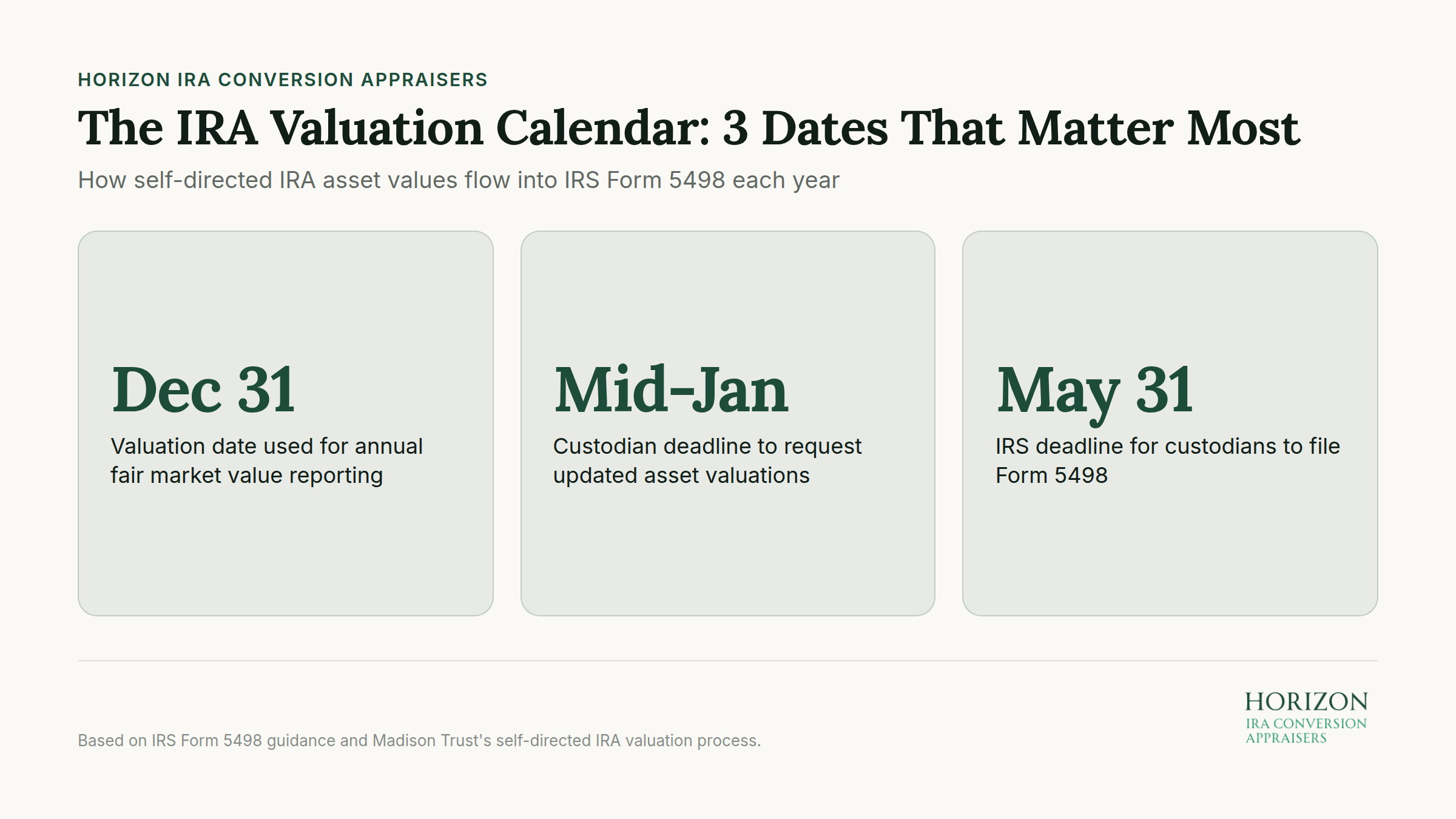
Three dates matter more than any other detail in this process:
- December 31: the valuation date every custodian uses for annual FMV reporting.
- Mid-January: the point at which most custodians, including Madison Trust, request updated valuations so they can be reflected on year-end statements.
- May 31: the IRS deadline by which custodians must file Form 5498 for the prior tax year.
Miss the custodian's internal cutoff (well before May 31) and you risk an inaccurate FMV on file, which can complicate everything from RMD calculations to a future Roth conversion.
How to Complete the IRA Asset Valuation Form, Section by Section
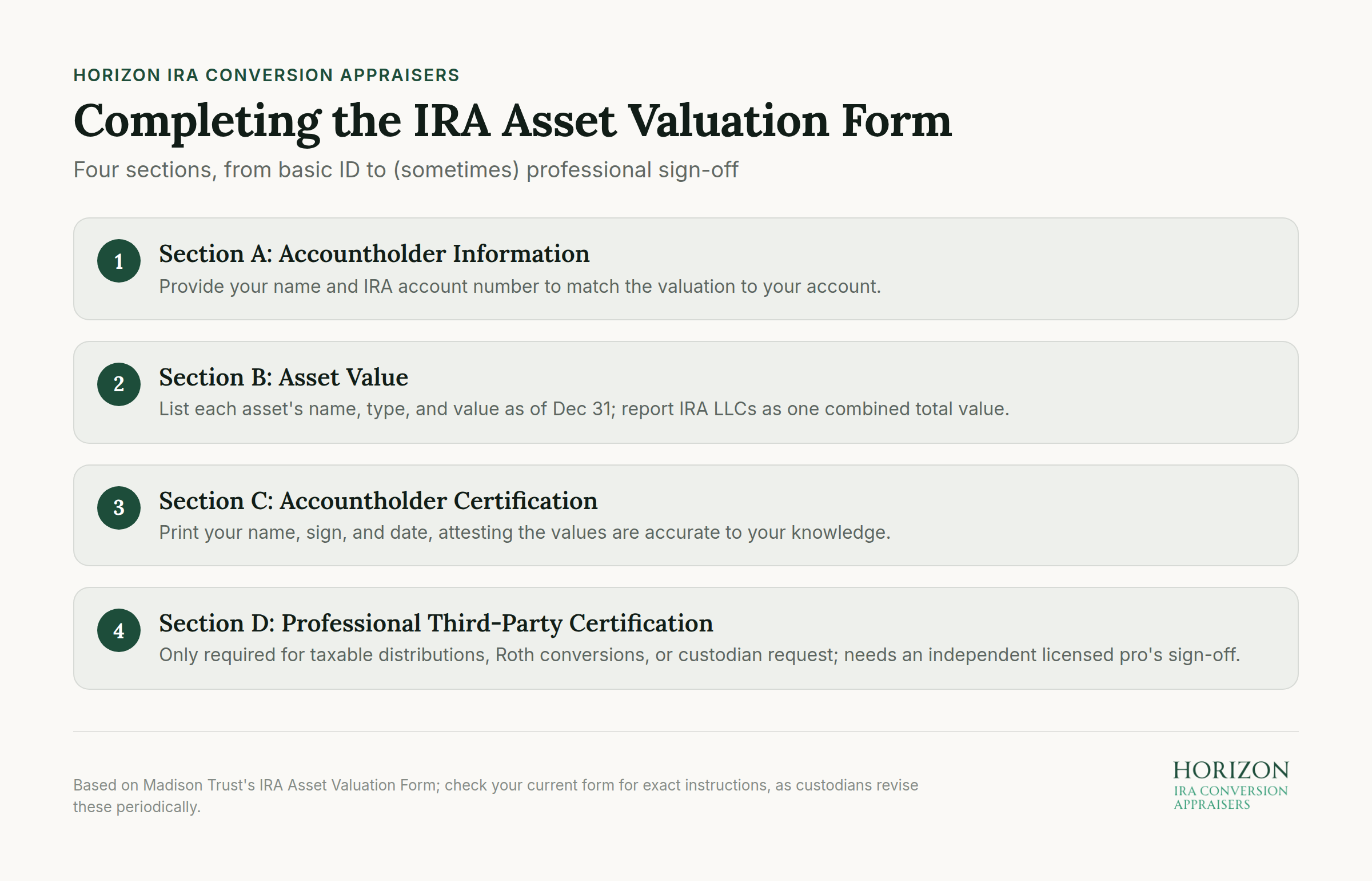
Madison Trust's IRA Asset Valuation Form (like similar forms used across the SDIRA custodian industry) is built around four sections that move from basic identification to, in some cases, a licensed professional's sign-off. Always check your current form for the exact submission instructions, since custodians revise these documents periodically, but the structure below reflects how these forms are typically organized.
- Section A: Accountholder Information
- You provide your name and your IRA account number so the custodian can match the valuation to the correct account.
- Section B: Asset Value
- For each asset in the IRA, you list the asset name, the asset type (single-member LLC, minority LLC interest, private placement, real estate, private loan, and similar categories), and its value.
- The IRA LLC nuance: if your IRA holds an LLC (a common checkbook-control structure), you report only the total value of the LLC itself, not each underlying asset held inside it. If the LLC owns a rental property and a savings account, you combine those into one LLC value rather than listing them as two separate line items.
- For every other asset type, you use the value as of December 31 of the year being reported.
- Section C: Accountholder Certification
- You print your name, sign, and date the form. This is your attestation that the reported values are accurate to the best of your knowledge.
- Section D: Professional Third-Party Certification
- This section is only required in specific circumstances: when the valuation supports a taxable distribution, a Roth conversion, or when the custodian specifically requests it. When triggered, a licensed professional who is not the accountholder must sign, attesting to the value independently.
For most routine annual reporting, Sections A through C are all that's needed. Section D is where things get more involved, and where our appraisers most often hear from Madison Trust account holders.
Who Can Sign the Professional Third-Party Certification?
When Section D applies, the signer has to be a qualified, independent professional rather than a friend with an accounting background. Custodians typically accept one of the following:
- A certified public accountant (CPA).
- A licensed attorney.
- A certified business appraiser.
- A certified valuation analyst (CVA), a credential issued through the National Association of Certified Valuators and Analysts.
- An IRS enrolled agent.
Whatever credential the signer holds, custodians generally expect the certification to include the professional's license or credential number and the state (or issuing body) under which they're authorized to practice. Madison Trust's own materials describe this third-party role explicitly, noting in one of its client explainer videos that an independent CPA or auditor typically signs off on valuations tied to taxable events.
Pro tip: if you know a Roth conversion or a distribution is coming later this year, line up your third-party certification early. Finding a qualified signer during the last week of tax season is harder than it needs to be.
The $0 LLC Attestation: a Common Edge Case When Closing a Checkbook IRA LLC
One scenario generates more inbound questions than any other: closing out a single-member, checkbook-control IRA LLC whose only remaining asset is a bank account being emptied to a $0 balance. The accountholder assumes that because the number is zero, no certification is needed. That assumption is wrong.
The custodian isn't asking you to prove that zero is a hard number to calculate. It's asking for confirmation that the number came from an independent source rather than the accountholder alone, because the certification is tied to the source of the attestation, not the complexity of the math. A certified business appraiser or a certified valuation analyst can review the LLC's final bank statement, operating agreement, and dissolution paperwork, and independently certify that the LLC's fair market value is $0 as of the valuation date. That review still needs to happen even when the outcome is obvious to everyone involved, because the custodian's compliance obligation is the same whether the value is $0 or $2 million.
Watch out: skipping the third-party sign-off on a dissolving LLC because "it's just zero" is one of the most common reasons Madison Trust and other custodians bounce a valuation form back to the accountholder.
What You Don't Need to Submit With the Form
Routine annual valuations typically don't require you to attach supporting documents like bank statements or appraisal reports to the form itself. The custodian may still request them separately if a specific asset raises questions, but the form's baseline submission usually doesn't demand a paper trail for ordinary Section A through C reporting.
That said, when our appraisers prepare a Section D certification, our engagement still involves reviewing the underlying records: the LLC's operating agreement, bank statements, closing documents, purchase agreements, or loan terms, depending on the asset. The form may not require you to attach that paperwork, but a credentialed signer can't certify a value without having actually looked at it.
Get an Independent Third-Party Certification for Your Madison Trust IRA Asset
We are not affiliated with Madison Trust Company. What we provide is the independent, credentialed certification that Section D of their form (and equivalent forms at other SDIRA custodians) requires when a valuation supports a Roth conversion, a taxable distribution, or a custodian's specific request.
Our appraisers hold credentials with organizations such as the ASA and NACVA, and every certification we prepare is completed in accordance with USPAP and includes the signer's license or credential number and state of authority, ready for your custodian's records. Whether you're certifying a rental property held in a self-directed IRA, a private LLC interest, or the final $0 attestation on a dissolving checkbook IRA LLC, we scope the assignment first and quote a fixed fee before any work begins. Fees reflect the complexity of the asset and the completeness of the records available, never the dollar value being certified.
If your SDIRA custodian has asked for a professional third-party certification, or you're preparing for a private stock or LLC interest valuation ahead of an IRA conversion, request an appraisal and we'll walk you through exactly what your custodian's form requires before we begin.
This article is provided for general informational purposes only and does not constitute legal, tax, or financial advice. Readers should consult a qualified attorney or CPA regarding their specific circumstances.