Blog
The IRS Penalty for Converting an SDIRA Asset Without a Qualified Appraisal
Converting an SDIRA asset to a Roth IRA without a qualified appraisal can trigger IRS accuracy-related penalties of 20% to 40% on the resulting underpayment, along with custodian delays and prohibited-transaction exposure. Here is how the IRC 6662 penalty structure works and why a qualified independent appraisal is your best defense.
Real estate, private equity, precious metals, and promissory notes held in a self-directed IRA (SDIRA) do not come with a daily market price. When you convert one of these assets to a Roth IRA, the fair market value (FMV) you report becomes the taxable event, and if that number is wrong, the consequences do not stop at an amended tax return. This article walks through why custodians hold up conversions without documentation, how the IRS evaluates an unsupported value at audit, and what the accuracy-related penalty structure under IRC 6662 actually charges you for guessing wrong. We prepare our Roth IRA conversion appraisal service specifically to close this gap before a conversion is filed, not after an audit letter arrives.
Why Your Custodian Won't Convert an Asset Without a Supportable Value
Most SDIRA custodians will not process a Roth conversion of a hard-to-value asset until they have a documented fair market value on file. This is not custodian caution for its own sake. Custodians are required to report annual FMV on Form 5498, and for alternative assets, that form includes a code identifying the asset as hard-to-value, which puts extra scrutiny on the number behind it.
Custodian trust companies that hold alternative assets describe the standard plainly: FMV has to be supported by reasonable, well-documented evidence of what a willing buyer would pay a willing seller in an arm's-length sale, as one custodian's guidance on alternative asset valuation explains. Without that evidence, many custodians will simply reject the conversion request or hold it pending an appraisal. Our detailed breakdown of Form 5498 fair market value reporting covers exactly what custodians expect to see before they will sign off.
Watch out: A self-reported estimate, a purchase price from 3 years ago, or a broker's verbal opinion is not documentation. Custodians and the IRS are both looking for a defensible valuation method tied to a specific date, not a number pulled from memory.
How an Unsupported Valuation Invites IRS Scrutiny
A Roth conversion is treated as a taxable distribution at FMV, followed immediately by a Roth contribution. If the reported FMV is too low, the taxpayer has effectively underreported the income created by the conversion. Once an examiner catches that, the IRS does not need a special SDIRA regulation to act. It restates the FMV, assesses the additional tax on the corrected amount, and layers penalties on top of the underpayment.
Government oversight reports have flagged unconventional IRA assets as a heightened area of noncompliance risk precisely because valuations are self-reported and hard to verify, which increases the odds that an undervalued conversion eventually gets a second look. The IRS also has a separate lever if the valuation issue is tangled up with a related-party transaction: the prohibited transaction rules under IRC 4975. If an IRA owner uses a self-serving valuation to justify buying, selling, or swapping assets with the IRA, an examiner can recharacterize the whole transaction as self-dealing rather than treat it as a simple math error.
The Accuracy-Related Penalty Structure Under IRC 6662
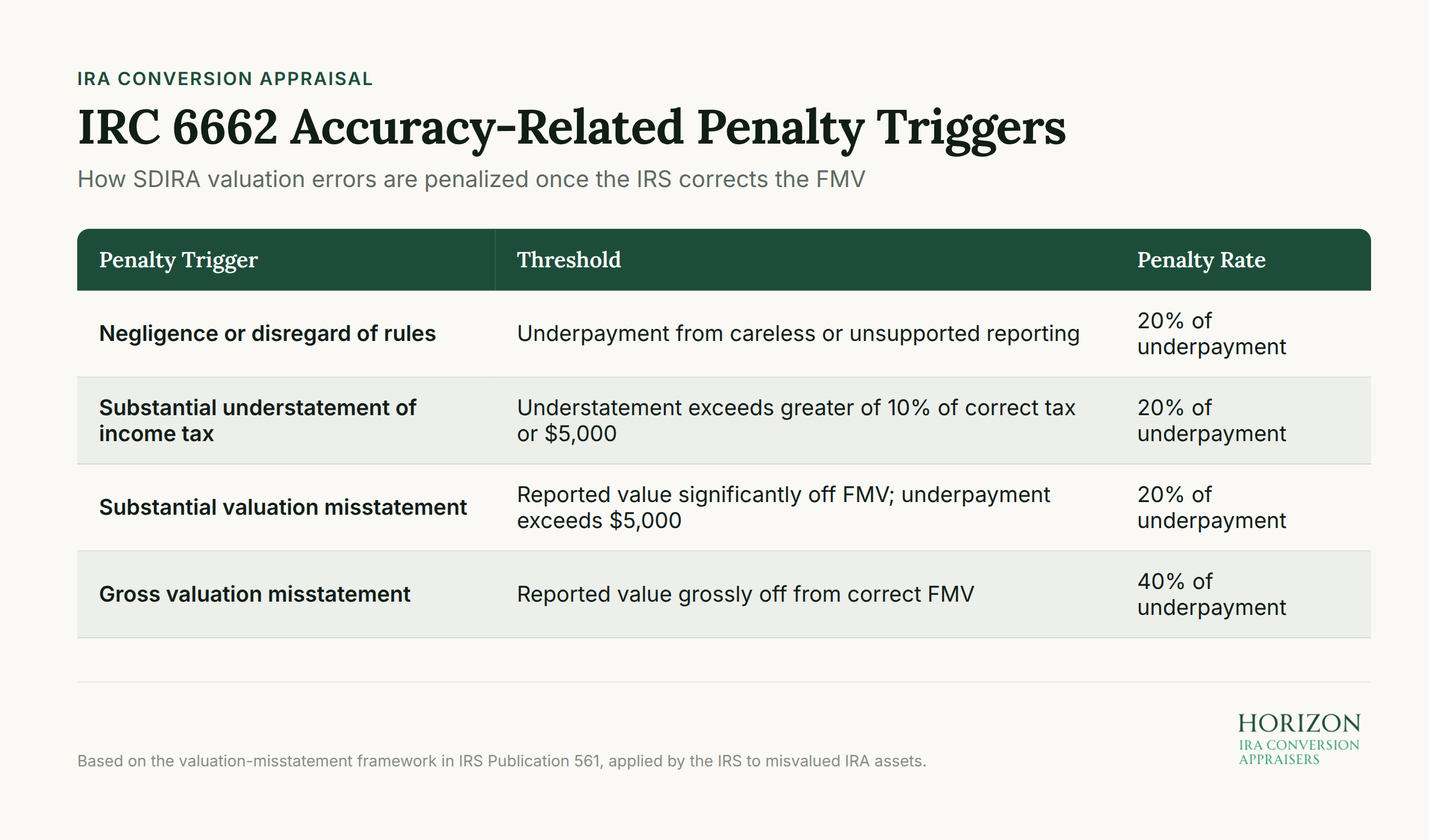
Once the IRS corrects an understated FMV, the resulting underpayment of tax is exposed to the accuracy-related penalty framework, which applies at either a 20% or 40% rate depending on how the error occurred and how large it is.
| Penalty Trigger | Threshold | Penalty Rate |
|---|---|---|
| Negligence or disregard of rules | Underpayment attributable to careless or unsupported reporting | 20% of the underpayment |
| Substantial understatement of income tax | Understatement exceeds the greater of 10% of the correct tax or $5,000 | 20% of the underpayment |
| Substantial valuation misstatement | Reported value is significantly off from the correct FMV and the underpayment exceeds $5,000 | 20% of the underpayment |
| Gross valuation misstatement | Reported value is grossly off from the correct FMV | 40% of the underpayment |
These tiers come from the same valuation-misstatement framework the IRS uses for reporting the FMV of donated and other misvalued property, and the IRS applies the same logic to an IRA asset whose reported value turns out to be wrong. The bigger the gap between what you reported and what the asset was actually worth, the closer you move from the 20% tier to the 40% tier.
Example: If a private equity interest converted at a reported FMV of $150,000 is later corrected to $300,000, the additional taxable income generates an underpayment. Depending on how far off the original number was and whether the IRS characterizes the error as a gross misstatement, that underpayment carries either a 20% or 40% penalty on top of the tax itself, plus interest accruing from the original filing date.
The Reasonable-Cause Defense: Why a Qualified Independent Appraiser Matters
Accuracy-related penalties are not automatic once a valuation is corrected. Taxpayers can raise a reasonable-cause and good-faith defense, and the strength of that defense depends heavily on whether the original value came from a qualified, independent source or from a guess.
An appraisal prepared by a credentialed appraiser working independently of the IRA owner, using a recognized valuation approach (income, market, or cost) and documented data sources, gives you something to point to if the IRS challenges the number later. An appraisal that came from the seller, a related party, or an informal estimate does not. Financial planning practitioners who study the disqualified-person rules under IRC 4975 note that the independence of the party doing the valuing matters as much as the number itself when a transaction is later examined, as covered in this analysis of the self-dealing and disqualified-person rules.
Key takeaway: The appraisal is not paperwork you file to satisfy a form. It is the evidence that supports your position if the IRS ever disputes the value you converted at, and it is the difference between an honest mistake and a penalty-triggering misstatement.
Our appraisers hold credentials with organizations including the ASA and NACVA for business and alternative-asset valuations, and every report is prepared in accordance with USPAP so it stands on its own if a custodian, CPA, or examiner asks how the number was reached.
Steps to Get the Appraisal Right Before You Convert
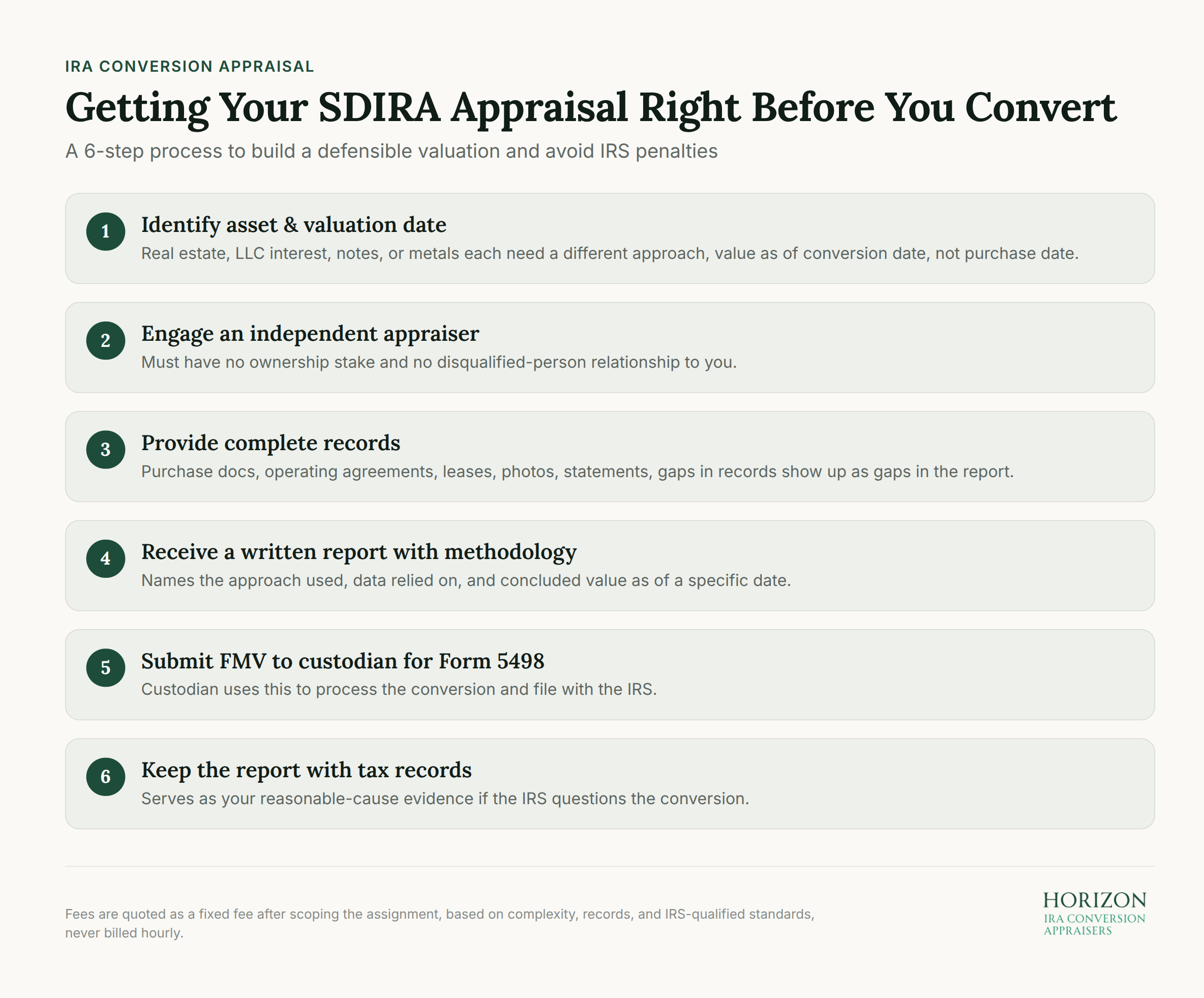
Getting the valuation right before you file is far cheaper than correcting it after an audit. The process generally runs in this order:
- Identify the asset and the valuation date. Real estate, an LLC interest, a promissory note, and physical precious metals each require a different valuation approach, and the value must be as of the conversion date, not the purchase date.
- Engage an independent, qualified appraiser. The appraiser should have no ownership stake in the asset and no relationship to you as a disqualified person under the IRA rules.
- Provide complete records. Purchase documents, operating agreements, leases, appraisal-relevant photos, or account statements all support a defensible conclusion; gaps in records show up as gaps in the report.
- Receive a written report with a stated methodology. A defensible appraisal names the approach used, the data relied on, and a concluded value as of a specific date, not just a single number.
- Submit the FMV to your custodian for Form 5498 reporting. This is the document your custodian uses to process the conversion and file with the IRS.
- Keep the report with your tax records. If the IRS ever questions the conversion, this report is your reasonable-cause evidence.
Fees for this kind of appraisal are quoted as a fixed fee after we scope the assignment, based on the asset's complexity, the completeness of available records, and whether the report needs to meet IRS-qualified standards. Engagements are quoted up front and never billed hourly.
What Happens If the Conversion Crosses Into a Prohibited Transaction
A simple undervaluation is a penalty problem. A valuation used to disguise a self-dealing transaction is a disqualification problem, and the two are treated very differently by the IRS.
If an IRA owner or beneficiary engages in a prohibited transaction, such as using a manipulated valuation to buy, sell, or swap an asset with the IRA itself, the IRS treats the IRA as ceasing to be an IRA as of January 1 of that year. Every asset in the account is treated as distributed at FMV on that date and taxed accordingly, and the 10% early-distribution penalty applies if the owner is under 59 1/2. Disqualified persons other than the owner face a separate excise tax of 15% of the amount involved per year, rising to 100% if the transaction is not corrected in time.
Pro tip: If your conversion involves any related party, whether a family member, a business partner, or an entity you control, get the appraisal from someone with zero connection to that party. This is where an unqualified appraisal stops being a penalty issue and starts being a disqualification issue.
Protect the Conversion Before You File
A Roth conversion of an SDIRA asset lives or dies on the fair market value behind it. Custodians will not move without documentation, examiners will not accept a guess, and the accuracy-related penalty structure under IRC 6662 exists specifically to punish valuations that cannot hold up. A qualified, independent appraisal does not just satisfy a custodian's checklist; it is the evidence that keeps a 20% or 40% penalty off your return if the IRS ever looks twice.
If you are planning a conversion of real estate, a private equity interest, precious metals, or a note held inside an SDIRA, request an appraisal before you submit the paperwork to your custodian.
This article is provided for general informational purposes only and does not constitute legal, tax, or financial advice. Readers should consult a qualified attorney or CPA regarding their specific circumstances.