Blog
Form 5498 Fair Market Value Rules for Self-Directed IRA Roth Conversions
IRS Form 5498 requires custodians to report the fair market value of hard-to-value self-directed IRA assets every year, and that same value sets the taxable amount when you convert to a Roth. Here is what boxes 15a and 15b require, why the conversion date valuation matters most, and what a qualified appraisal needs to show.
If you hold real estate, private equity, LLC interests, notes, or precious metals inside a self-directed IRA, your custodian has to report a fair market value (FMV) for that asset to the IRS every year on Form 5498, and that same FMV determines how much tax you owe the moment you convert the asset to a Roth IRA. Box 15a captures the dollar value; box 15b identifies the asset type using an IRS code. Get the valuation wrong on a conversion date and you either overpay tax or leave yourself exposed on audit.
What Does IRS Form 5498 Require for Hard-to-Value IRA Assets?
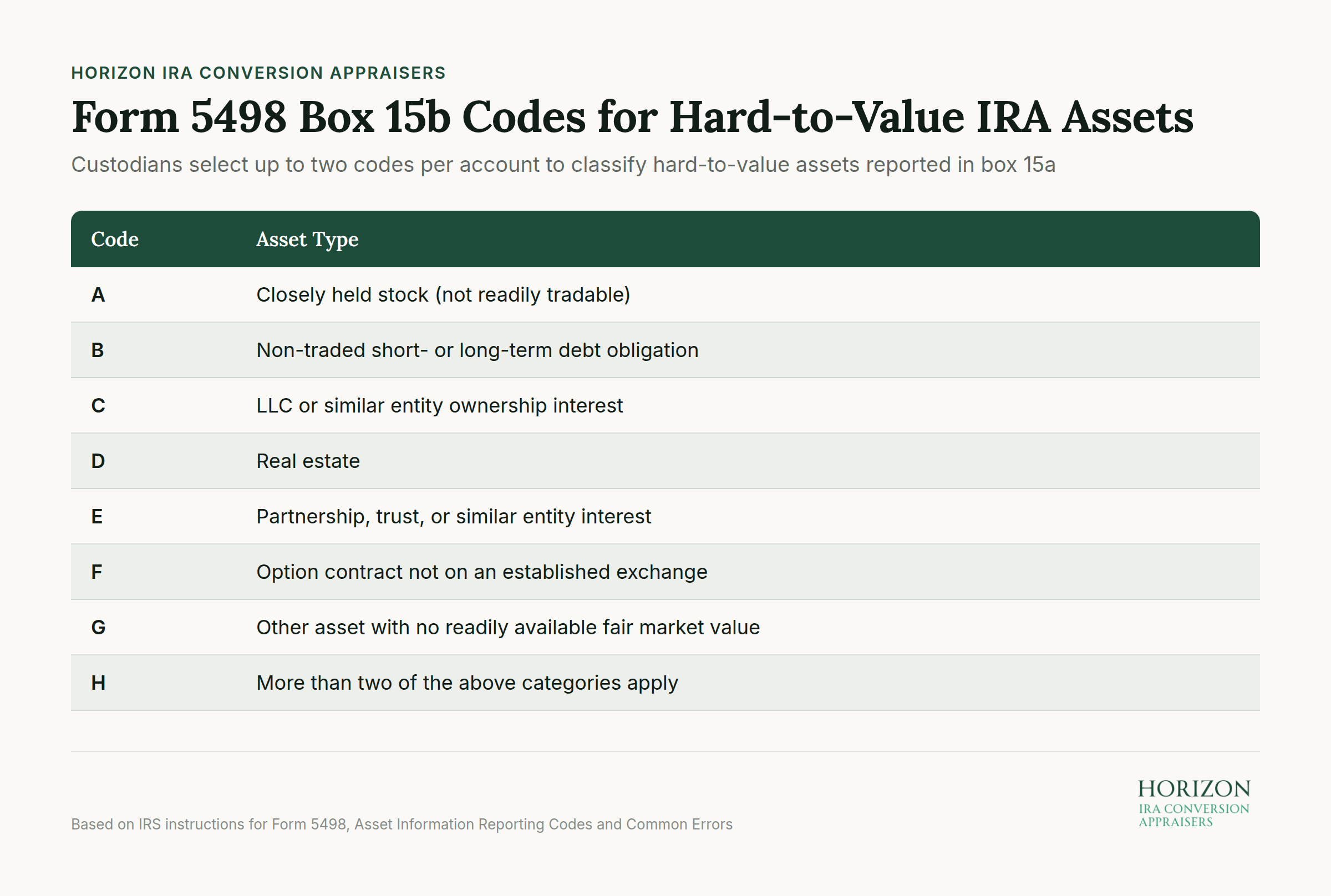
Form 5498 requires custodians, trustees, and issuers to report the fair market value of certain "hard-to-value" IRA assets in box 15a, valued as of December 31 of the reporting year, and to identify the asset category in box 15b using a letter code. The IRS instructions for Form 5498 list the specific codes custodians must choose from, and up to two codes can be entered per account.
The box 15b categories cover the exact asset types that show up most often in self-directed IRAs:
- A: Stock or other ownership interest in a corporation that is not readily tradable on an established securities market.
- B: Short- or long-term debt obligation that is not traded on an established securities market.
- C: Ownership interest in a limited liability company or similar entity (unless the interest is traded on an established securities market).
- D: Real estate.
- E: Ownership interest in a partnership, trust, or similar entity (unless the interest is traded on an established securities market).
- F: Option contract or similar product not offered for trade on an established option exchange.
- G: Other asset that does not have a readily available fair market value.
- H: More than two of the above categories apply to a single account.
Because none of these assets trade on a public exchange, there is no ticker price the custodian can pull to satisfy box 15a. The value has to come from somewhere, and that somewhere is typically an independent appraisal.
Why Does Fair Market Value Matter So Much at the Moment of Roth Conversion?
A Roth conversion is taxed based on the fair market value of the assets treated as distributed on the conversion date, not on the value at the start or end of the year. The IRS's own guidance on Roth conversions confirms that the amount included in income is tied to the value at conversion (reduced by any after-tax basis under the pro-rata rules that apply when a taxpayer holds multiple traditional IRAs).
This matters more for a hard-to-value asset than for a mutual fund. If you convert 10,000 shares of a publicly traded stock, the value is whatever the market says it is that day. If you convert a 15% interest in a family LLC that holds a rental property, or a promissory note secured by a small business, there is no market quote to fall back on. The number on your Form 1099-R, and the tax you owe, depends entirely on the appraised value assigned to that asset as of the conversion date.
Watch out: Converting an illiquid asset without a contemporaneous, dated appraisal leaves the taxable amount effectively undocumented. If the IRS questions the value later, you want a report that was prepared at the time of conversion, not one reconstructed after the fact.
What Are DLOM and DLOC, and Why Aren't They Guaranteed?
A discount for lack of marketability (DLOM) reflects that an interest cannot be readily sold or converted to cash, while a discount for lack of control (DLOC) reflects that a non-controlling interest cannot direct management, force a sale, or compel a distribution. Both are valuation concepts a qualified appraiser may apply to fractional, non-controlling, or LLC-held interests where the underlying facts support them.
Neither discount is automatic, and neither carries a fixed IRS-approved percentage. Whether a discount applies, and how large it is, depends on the specific facts of the interest being valued:
- Governing documents: What does the LLC operating agreement or partnership agreement say about transfer restrictions, buy-sell provisions, and voting rights?
- Control rights: Does the interest carry any say over management decisions, distributions, or a sale of the underlying asset?
- Market evidence: What do comparable transactions or restricted-stock studies show for similarly situated interests?
A qualified appraiser evaluates these factors and reaches a supportable conclusion; sometimes that conclusion includes a discount, sometimes it does not. Anyone who promises you a specific discount percentage before reviewing the entity's actual documents is not doing valuation work, they are guessing. This is one of the areas where a credentialed appraiser working under recognized professional standards, rather than a generic online estimate, protects you at conversion time.
What Do Self-Directed IRA Custodians Require From an Appraisal?
Custodians of self-directed IRAs generally require an independent, third-party valuation for hard-to-value assets because they need a defensible FMV to satisfy their own annual reporting obligation on Form 5498. This is a recurring, not one-time, requirement: the IRS instructions for Forms 1099-R and 5498 direct custodians to report the fair market value of the account each reporting cycle, so custodians typically ask for an updated valuation every year for alternative assets that lack a public price.
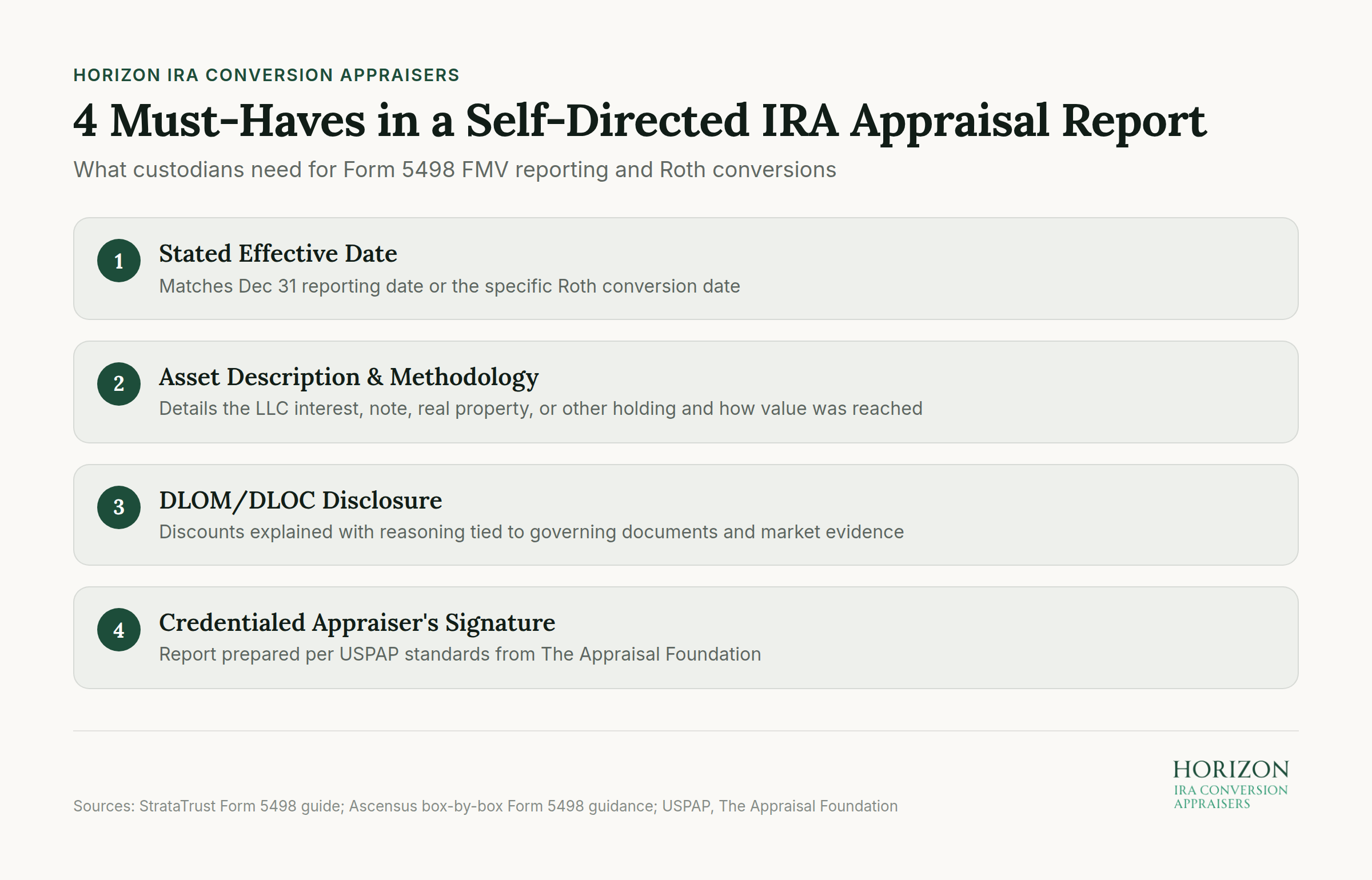
A useful appraisal for this purpose typically includes:
- A stated effective date matching either the December 31 reporting date or the specific Roth conversion date.
- A description of the asset (the LLC interest, note, real property, or other holding) and the methodology used to reach the concluded value.
- Disclosure of any DLOM or DLOC applied, with the reasoning tied to the entity's governing documents and market evidence.
- A credentialed appraiser's signature, prepared in accordance with the Uniform Standards of Professional Appraisal Practice (USPAP), published by The Appraisal Foundation.
Custodians rarely spell out exactly what report format they want, which is why many self-directed IRA owners lean on their self-directed IRA custodian relationship to confirm requirements before ordering an appraisal. Custodian reporting practices for these codes are also summarized in industry box-by-box guidance for Form 5498, which walks through how each asset category typically gets documented.
How We Approach Self-Directed IRA and Roth Conversion Valuations
We prepare independent fair market value appraisals for the closely held stock, LLC interests, promissory notes, and private equity positions that commonly sit inside self-directed IRAs, structured to meet both custodian reporting requirements and the documentation standard you want on file for a Roth conversion. Our appraisers hold credentials with organizations such as the National Association of Certified Valuators and Analysts and the American Society of Appraisers, and every report is prepared in accordance with USPAP.
For LLC or partnership interests specifically, our business valuation engagements for interests of this kind are quoted from $4,500 for a standard report and from $5,500 for an IRS-qualified report, with typical fees running $7,500 to $12,000 depending on the entity's complexity and the number of interests involved. For real estate held inside a self-directed IRA, a qualified real property appraiser establishes the reportable value; that work sits outside our scope, and we would point you to a specialist in that vertical. Every engagement we do is a fixed fee, quoted after we scope the assignment, never billed hourly.
Pro tip: Order the appraisal before you execute the conversion, not after. The valuation needs an effective date tied to the conversion itself, and custodians generally cannot process the transaction on a value that does not yet exist on paper.
Frequently Asked Questions
Q: Does every Roth conversion of a self-directed IRA asset need a new appraisal? Yes, for any hard-to-value asset. Because the taxable amount of a conversion is based on the fair market value as of the conversion date, a stale year-end valuation will not support the transaction; you need a valuation effective as of, or reasonably close to, the actual conversion date.
Q: What is the annual FMV reporting requirement for hard-to-value IRA assets? Custodians must report the fair market value of specified hard-to-value assets in box 15a of Form 5498 each year, valued as of December 31, and identify the asset category in box 15b. This is a recurring obligation, not a one-time filing, so the custodian typically requests an updated valuation annually.
Q: Will a discount for lack of marketability or control automatically reduce my taxable conversion amount? No. A DLOM or DLOC is applied only where the facts of the specific interest, its governing documents, transfer restrictions, and control rights, support it. There is no guaranteed IRS percentage, and a qualified appraiser may conclude that no discount is warranted depending on the entity's structure.
Q: How long does a self-directed IRA asset appraisal take? Turnaround depends on the asset type and the completeness of the records provided (operating agreements, note terms, entity financials). Once the assignment is scoped and the fixed fee is confirmed, most engagements move quickly because the report only needs to address the specific interest and its supporting facts, not a full enterprise valuation.
Q: Can I use last year's appraisal for this year's conversion? No. Values change, and both the custodian's annual reporting obligation and the conversion's tax treatment depend on a current, dated valuation. An appraisal prepared for last year's Form 5498 does not establish the fair market value on this year's conversion date.
Get Your Conversion Documented Correctly
A Roth conversion of an illiquid IRA asset is a one-time tax event built on a single number. If you are converting an LLC interest, private equity stake, or promissory note, request an appraisal before you initiate the transaction so the fair market value on record matches the value your custodian and the IRS expect to see. For more on how conversion timing interacts with the five-year holding rules, see our guide to the Roth IRA conversion five-year rule.
This article is provided for general informational purposes only and does not constitute legal, tax, or financial advice. Readers should consult a qualified attorney or CPA regarding their specific circumstances.