Blog
What Does an Appraisal Cost for a Self-Directed IRA Roth Conversion?
A self-directed IRA Roth conversion appraisal typically runs from a few hundred dollars for a straightforward rental property to $5,000-$20,000+ for a private LLC or business interest. This guide breaks down what drives the price and how minority interest and marketability discounts change your taxable conversion amount.
Converting a hard-to-value asset inside a self-directed IRA to a Roth IRA is a taxable event, and the tax bill is calculated on the fair market value of that asset on the conversion date. For cash or publicly traded securities, that number is easy. For real estate, private LLC interests, promissory notes, or precious metals, it isn't, and that's where an independent appraisal comes in. The short answer on cost: for a single asset, expect fees between $6,500 and $8,000. Our most basic engagements start around $5,000, and complex, multi-asset entities can run $20,000 or more.
Why a Self-Directed IRA Roth Conversion Needs an Appraisal
When you convert non-cash IRA assets to a Roth IRA, your custodian reports the fair market value of the conversion to the IRS, and you report the taxable amount on your own return. There isn't a single IRS form titled "appraisal requirement," but the mechanics leave no real alternative for hard-to-value assets.
Here's how the pieces fit together:
- Form 5498 is the form your custodian files to report the fair market value of your IRA. For assets without a readily determinable market price, custodians generally rely on an independent, third-party valuation to support that figure.
- Form 8606 is the form you file to report the conversion and the taxable amount that lands on your return.
- The conversion date value is what matters. Not last year's value, not what you paid for the asset originally.
Most custodians will not process a Roth conversion involving real estate, a private LLC interest, or another hard-to-value holding without a written, independent valuation on file. This isn't optional paperwork; it's how the custodian and the account holder both stay defensible if the conversion is ever questioned. We prepare every appraisal in accordance with USPAP (the Uniform Standards of Professional Appraisal Practice) specifically to meet IRS and custodian expectations for this kind of reporting. No appraisal firm, including ours, can promise you a specific tax outcome or guarantee that a reviewer will accept a given number; what a credentialed, standards-compliant report does is give you a defensible basis for the value you report.
Pro tip: Ask your custodian, before you start the conversion, exactly what documentation they require. Some custodians want the appraisal in hand before they'll process the transaction, and building in that lead time avoids a scramble near year-end.
What Drives the Cost of an IRA Conversion Appraisal
The cost of an appraisal for a self-directed IRA Roth conversion is driven by four things: the type of asset, how complex that specific asset is, how many assets or entities are involved, and whether a formal discount analysis is required. These are all scope questions: the more analysis and documentation review an assignment requires, the higher the fee.
Asset Type
A rental property held through an IRA-owned LLC, a fractional interest in raw land, a single-member LLC holding one asset, and a multi-member LLC with a detailed operating agreement all require different scopes of work. Real estate holding entities are valued at the entity level: the analysis covers the underlying property and the ownership structure together, because what's being converted is the entity interest, not the deed. Private LLC and company interests require a full business valuation, often using income, market, and asset-based methods together, plus a separate discount analysis. Promissory notes are valued through a discounted cash flow or market yield analysis. Precious metals that meet IRS purity and custody requirements are usually valued off quoted spot prices rather than a narrative appraisal.
Complexity Within the Asset Class
A single-member LLC holding one asset is a much simpler assignment than a multi-member LLC with transfer restrictions, buy-sell provisions, or a history of irregular distributions. The records behind the entity matter just as much: clean financial statements, a current operating agreement, and organized supporting documents keep the scope contained, while incomplete or messy documentation adds analysis time. The more documentation an appraiser has to review and the more judgment calls a valuation requires, the higher the fee.
Number of Assets or Accounts
If your SDIRA-owned LLC holds several properties, notes, or investments, each underlying asset generally needs its own valuation before the entity-level value can be calculated. Converting one clean asset costs less than converting an entity that holds five different investments. When multiple assets are involved, the total fee runs higher than a single-asset engagement, but each asset is priced at a discount relative to appraising it on its own.
Whether a Discount Analysis Is Required
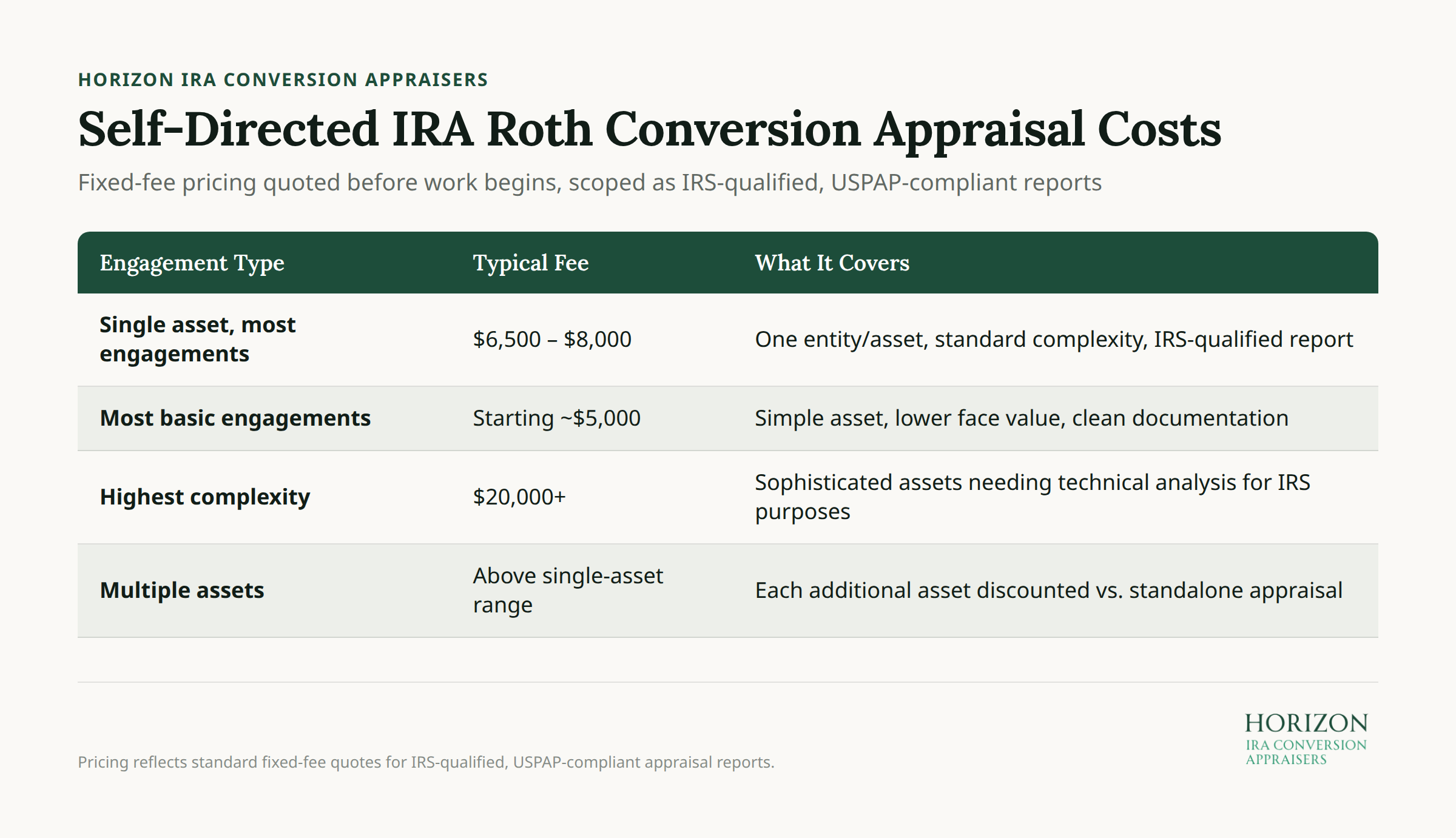
Appraising a non-controlling, illiquid interest in a private LLC or company involves additional financial analysis beyond a straight asset value; this discount work adds time and cost that a simpler entity appraisal doesn't carry.
What an IRA Conversion Appraisal Typically Costs
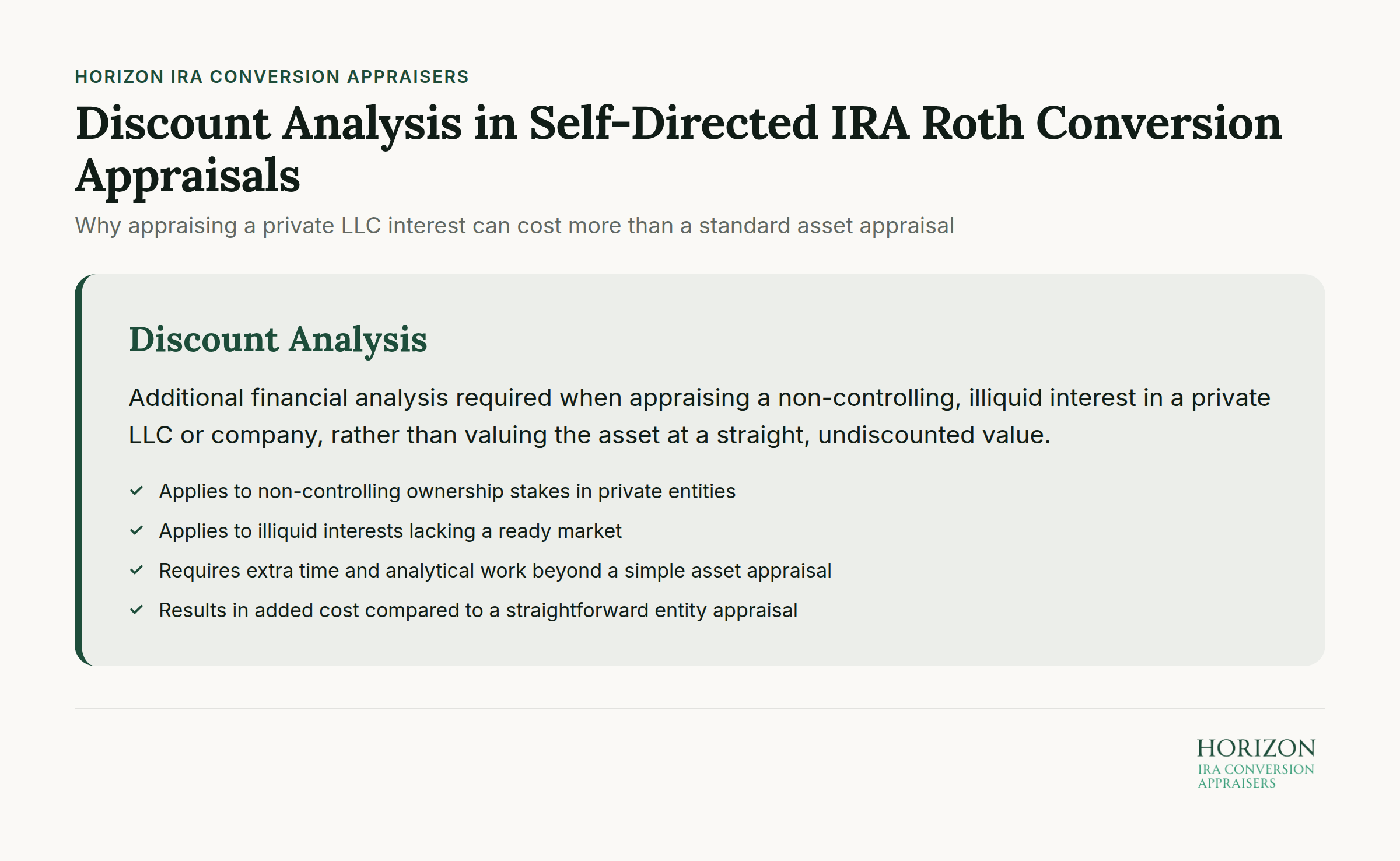
Here is how those drivers translate into actual fees. These figures reflect our standard pricing, and every engagement is quoted as a fixed fee before work begins, so you'll know the exact cost before you commit to anything.
| Engagement | Typical Fee | What It Covers |
|---|---|---|
| Single asset, most engagements | $6,500 – $8,000 | One entity or asset of standard complexity, IRS-qualified report |
| Most basic engagements | Starting around $5,000 | A simple financial asset with lower face value and clean documentation |
| Highest complexity | $20,000+ | Sophisticated financial assets requiring highly technical analysis and increased detail for IRS purposes |
| Multiple assets | Above the single-asset range | Each asset priced at a discount relative to a standalone appraisal |
A Roth conversion is an IRS reporting purpose, so the assignment is scoped as an IRS-qualified, USPAP-compliant report from the outset. We don't bill by the hour: after an initial review of your ownership structure and materials, we propose a fixed fee, and that's the number you pay.
How Minority Interest and Marketability Discounts Change Your Taxable Amount
If your SDIRA owns a non-controlling, illiquid stake in an LLC or private company, the fair market value used for your Roth conversion is often lower than a simple pro-rata share of the entity's total value. That's because a willing buyer would pay less for a minority, illiquid position than for full, liquid control of the same underlying assets, and appraisers apply two separate, well-established adjustments to reflect that reality.
- Discount for lack of control (DLOC): A minority interest can't force a sale, set distribution policy, or direct management decisions, so a buyer typically pays less per unit than for a controlling stake.
- Discount for lack of marketability (DLOM): There's no public market for shares in a private LLC, and operating agreements often restrict who the interest can be sold or transferred to, which further reduces what a buyer would pay today.
These two discounts are applied multiplicatively, one on top of the other, and both are grounded in decades of accepted business valuation theory rather than being a recent workaround. What they are not is a rule of thumb an account holder or a bookkeeper can plug in. A credible discount has to be tied to the specific facts of the interest, including the entity's operating agreement, its history of distributions, any transfer restrictions, and the realistic pool of buyers for that stake. Our private stock appraisal for IRA conversions guide walks through how this plays out for private company shares specifically, and our piece on discounted Roth IRA conversion valuations goes deeper into how the math works.
Example: An IRA holds a 25% non-controlling interest in an LLC whose underlying real estate is worth $1,000,000. A pro-rata share would be $250,000, but a qualified appraiser might conclude that a minority, illiquid interest of this kind is worth meaningfully less once control and marketability are factored in. That lower, appraised figure, not the simple pro-rata number, is what should be reported as the taxable conversion amount.
Watch out: Discounts that aren't supported by entity documents, financial history, and defensible methodology invite scrutiny. The savings from a legitimate discount only hold up if the appraisal behind it does.
Who Can Perform This Appraisal
This work should be handled by a credentialed appraiser, not estimated internally or borrowed from a prior year's number. Horizon Business Valuations prepares Roth conversion appraisals for the asset types self-directed IRAs commonly hold: real estate holding entities, private LLC and company interests, promissory notes, and tangible personal property including precious metals. Our appraisers hold credentials with organizations such as the American Society of Appraisers and the National Association of Certified Valuators and Analysts, and every report is prepared in accordance with USPAP to meet IRS and custodian requirements for conversion reporting.
We are the firm doing this work, not a referral service pointing you toward someone else. If you're weighing a conversion and need to understand what your SDIRA's private holdings are actually worth on paper, our Roth IRA conversion appraisal team can walk you through the process and scope the assignment before you commit to a conversion date.
Frequently Asked Questions
Q: How much does it cost to appraise a self-directed IRA for a Roth conversion? For a single asset, expect fees between $6,500 and $8,000. Our most basic engagements start around $5,000, and complex assets can exceed $20,000. When multiple assets are involved, the total runs above the single-asset range, but each asset is priced at a discount, and the full fee is fixed and quoted before work begins.
Q: Does my SDIRA custodian require an appraisal before a Roth conversion? Most custodians require a written, independent valuation before processing a conversion involving real estate, a private LLC interest, or another hard-to-value asset. Check with your specific custodian early, since some require the appraisal on file before they'll even initiate the transaction.
Q: What is a minority interest discount and does it apply to my SDIRA-owned LLC? A minority interest (or lack-of-control) discount reflects that a non-controlling stake in an entity is worth less per unit than a controlling one, because the holder can't direct management or force a sale. Whether it applies to your account depends on your actual ownership percentage, the entity's operating agreement, and its transfer restrictions; it isn't automatic, and it has to be supported by a qualified appraisal.
Q: Who can perform this appraisal? A credentialed, independent appraiser with relevant experience in the asset type involved, real estate, business valuation, or personal property, should complete the work. Custodians generally do not consider your personal CPA or a related party independent enough for this purpose, and the report should follow USPAP.
Understanding what drives the cost of your appraisal, and whether a discount analysis applies to your holdings, puts you in a much better position heading into a Roth conversion than guessing at a number and hoping it holds up. If you're ready to scope out an appraisal for your self-directed IRA, request an appraisal and we'll walk you through what your specific assets will require.
This article is provided for general informational purposes only and does not constitute legal, tax, or financial advice. Readers should consult a qualified attorney or CPA regarding their specific circumstances.