Blog
Do I Need an Appraisal to Convert an IRA to Roth When It Holds Private Assets?
If you are asking whether you need an appraisal to convert an IRA to a Roth, the short answer is that no IRS rule mandates one by name, but conversion-date fair market value is mandatory. This guide explains which private assets need a valuation, what the report documents, and what to gather first.
Published
Key Takeaways on Appraisals for Roth Conversions of Private IRA Assets
Here is what account holders need to know about appraisals when converting privately held IRA assets to a Roth IRA:
- No named mandate: The IRS does not expressly require an independent appraisal solely because a conversion involves an LLC interest or private stock.
- Mandatory value: A fair market value (FMV) as of the conversion date is required to compute the taxable amount reported on Form 8606.
- Custodian practice: Custodians of a self-directed IRA commonly require independent valuation support for assets that have no market price.
- Wrong numbers: Cost basis and a prior year-end custodian statement value do not establish conversion-date FMV.
- Separate dates: Each IRA that converts an interest in the same entity needs its own FMV as of its own conversion date.
An IRA owner who converts a traditional IRA holding private assets to a Roth IRA must report the converted amount at fair market value on the conversion date. The IRS does not attach a separate appraisal mandate to that step, but the value drives taxable income, so the number needs evidence behind it. This guide covers what the rules require, which assets need a valuation, what a report documents, and which records to gather.
Is an Appraisal Required to Convert an IRA to a Roth IRA?
No single IRS rule requires an independent appraisal for every Roth conversion of privately held IRA assets. The IRS does require that the converted amount reflect FMV on the conversion date, and an appraisal is the most defensible way to establish that value for an asset with no quoted price.
IRS Publication 590-A describes a conversion as a distribution from a traditional IRA that is contributed to a Roth IRA, and it confirms that property can move in kind without a prior sale. The taxable amount generally equals the FMV of that property, less any nondeductible basis. No dollar threshold exempts a private asset from valuation. The need for support depends on liquidity, complexity, and how much the reported value affects the return.
Publicly traded securities sit at the easy end of the range, because market quotations establish FMV. LLC interests, partnership interests, and closely held shares sit at the other end, because no quotation exists.
Why Conversion-Date FMV Is Mandatory for Form 8606
IRS Form 8606 and its instructions require the taxpayer to report the converted amount, and that amount depends on the property's FMV when the conversion occurs. A taxpayer who reports an unsupported number carries the burden of substantiating it if the IRS questions the return.
The IRS Form 1099-R and Form 5498 instructions identify LLC interests, non-traded corporate stock, partnership interests, and real estate as assets that are hard to value. Custodians face the same difficulty these instructions describe, and the custodian's reporting does not remove the taxpayer's responsibility to support the figure on the return.
A related limit applies regardless of valuation. A conversion that involves a disqualified person can still violate the prohibited-transaction rules of Internal Revenue Code Section 4975, even with a clean appraisal. Valuation and transaction structure are separate questions, and both need attention.
Why Custodian Statements and Cost Basis Do Not Settle Fair Market Value
A custodian statement value rarely equals conversion-date FMV for a private asset. Many custodians of alternative assets carry the prior year-end figure, or a figure the account holder supplied, because the custodian has no independent way to price the holding.
Cost basis fails for a different reason. Cost basis records what the IRA paid for the asset, and FMV records what a willing buyer and willing seller would agree on today. An LLC interest bought for $100,000 three years ago can be worth more or less on the conversion date, depending on the entity's earnings, assets, and outlook.
IRS Publication 561 defines fair market value as the price a willing buyer and willing seller would agree on, with neither under pressure to act and both having reasonable knowledge of the relevant facts. Neither a stale statement nor a purchase price meets that definition on a specific date.
Form 5498 Box 5 Versus Conversion-Date FMV
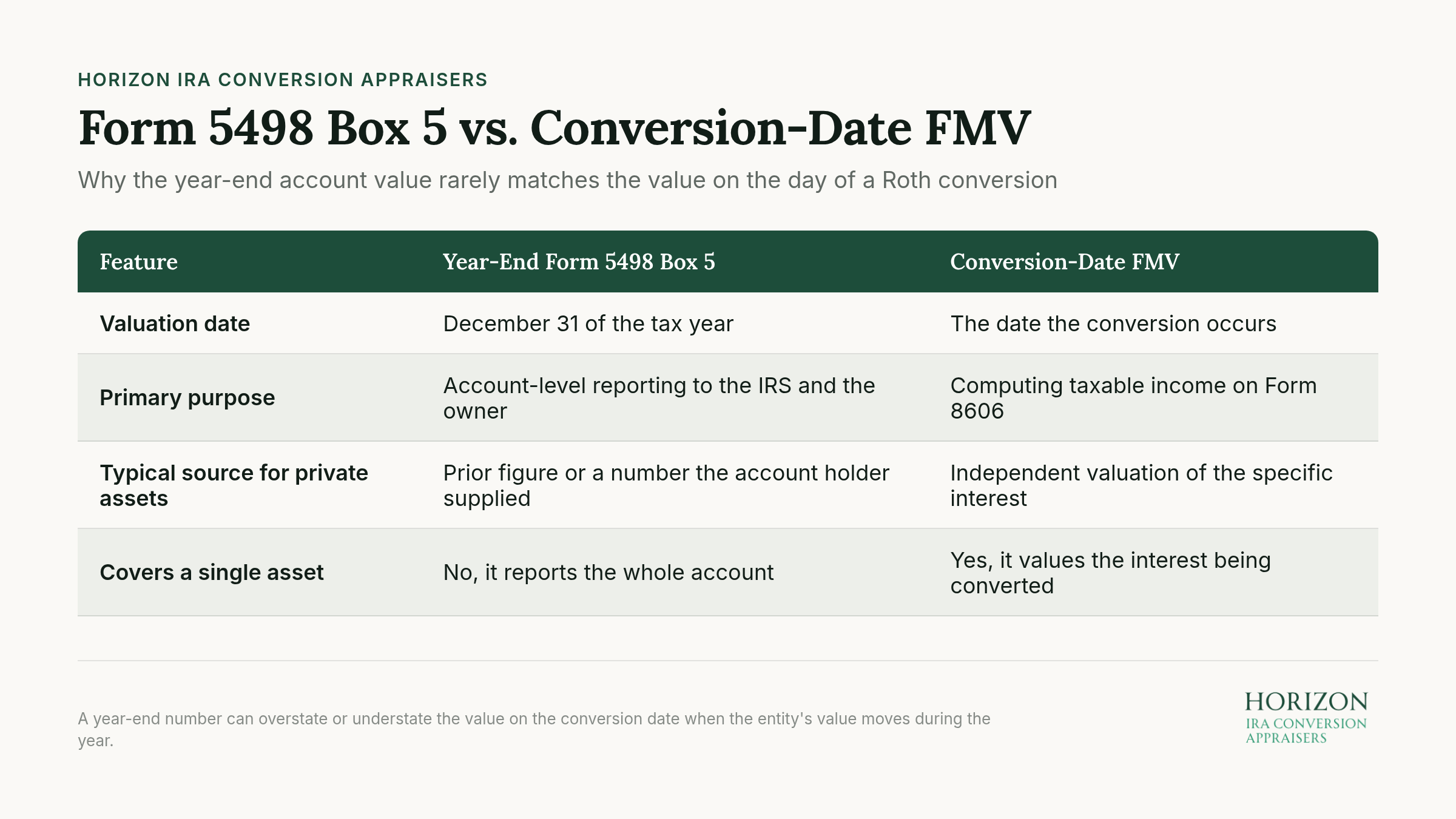
Form 5498 Box 5 reports the FMV of the account as of December 31. A conversion happens on a specific date during the year, and the two dates seldom match. The table below compares the two values.
| Feature | Year-End Form 5498 Box 5 Value | Conversion-Date FMV |
|---|---|---|
| Valuation date | December 31 of the tax year | The date the conversion occurs |
| Primary purpose | Account-level reporting to the IRS and the owner | Computing taxable income on Form 8606 |
| Typical source for private assets | Prior figure or a number the account holder supplied | Independent valuation of the specific interest |
| Covers a single asset | No, it reports the whole account | Yes, it values the interest being converted |
The distinction matters most when the entity's value moves during the year. A year-end number can overstate or understate the value on the day of conversion. Our guide to Form 5498 fair market value rules for self-directed IRA Roth conversions covers the reporting mechanics in more detail.
Which Private IRA Assets Typically Need a Valuation for Conversion?
Private assets with no quoted market price typically need a valuation before conversion. The assets that arise most often are:
- LLC and partnership interests: The report values the interest the IRA holds, not the gross value of the entity's underlying assets.
- Private company shares: Closely held and pre-IPO stock has no daily price, and transfer restrictions reduce what a buyer would pay.
- Real estate holding entities: An LLC that owns property needs a valuation of the entity interest, which accounts for debt, expenses, and the rights attached to the interest.
- Private notes: Second mortgages and similar notes depend on the borrower's payment history, the collateral, and the note's terms.
- Fund interests: Interests in private equity, real estate, and similar funds carry their own redemption limits and reporting lags.
Fractional ownership raises its own questions about control and marketability. Our fractional interest appraisal for IRA conversion service addresses those questions directly.
What an IRA Conversion Appraisal Report Documents
A conversion appraisal report documents the interest being valued, the valuation date, the methodology, and every adjustment the appraiser applied. The report supports the figure placed on the return, so each input needs a stated basis.
A complete report identifies the following items:
- The asset, the IRA's ownership percentage, and the valuation date
- The standard and premise of value, which is fair market value under IRS guidance
- The rights attached to the interest, including voting, distribution, and liquidation rights
- Transfer restrictions in the operating agreement or shareholder agreement
- The methodology, such as the income, market, or asset-based approach
- Any discount for lack of control (DLOC) or lack of marketability (DLOM), with the support for each
- The appraiser's qualifications and the assumptions and limiting conditions
IRS Revenue Ruling 59-60 remains the principal published IRS framework for valuing closely held stock. It lists factors such as the company's history, economic outlook, book value, earning capacity, dividend-paying capacity, goodwill, prior sales, and comparable securities. Horizon IRA Conversion Appraisers prepares reports in accordance with USPAP and applies the FMV standards in IRS Publication 561.
Discounts for Lack of Control and Marketability
A minority interest in a private entity typically sells for less than a pro rata share of the entity's value, because the holder cannot direct operations or force a sale. A DLOC reflects that missing control, and a DLOM reflects the difficulty of selling an interest with no ready market.
Watch out: A discount applies only when the governing documents and the characteristics of the interest support it. An appraiser cannot select a discount to reduce conversion income. Our article on minority interest and marketability discounts in SDIRA Roth conversions explains how those adjustments are supported.
Multiple IRAs Holding Interests in the Same Entity
Each IRA that holds an interest in the same entity needs FMV as of its own conversion date. Two IRAs that convert on different dates can carry different values, even when both hold the same type of interest in the same LLC.
Example: An account holder owns LLC interests in a traditional IRA at one custodian and in a second traditional IRA at another. The first IRA converts in March, and the second converts in September. Each conversion needs a valuation as of its own date, and each interest is valued on its own percentage and rights.
The percentage each IRA holds also affects the result. A larger block can carry more influence over the entity than a smaller one, and the report reflects that difference.
Documents to Gather Before a Conversion Valuation
An appraiser needs the entity's governing and financial records to value the interest. Gathering them before the conversion date shortens the timeline and strengthens the report.
Have the following records ready:
- The operating agreement, partnership agreement, or shareholder agreement
- Financial statements and tax returns for the entity, usually for the last 3 to 5 years
- The capitalization table or the list of members and their ownership percentages
- The IRA custodian's statements and the date of the planned conversion
- Subscription documents or the purchase agreement showing what the IRA paid
- Appraisals of real estate or equipment the entity owns, where those exist
- Notes, loan agreements, and payment histories for private-note holdings
- Records of recent sales or offers involving the entity's interests
Pro tip: Confirm the conversion date with the custodian in writing. The valuation date must match the date the custodian records the in-kind transfer.
How Horizon IRA Conversion Appraisers Handles Conversion Valuations
Horizon IRA Conversion Appraisers appraises LLC interests, partnership interests, private stock, and other hard-to-value IRA holdings for Roth conversions. Our appraisers hold credentials with leading organizations such as the ASA and NACVA, and the work is prepared in accordance with USPAP.
Engagements are quoted as a fixed fee after we scope the assignment, and the fee is set before work begins. Scope depends on the complexity of the entity, the completeness of its records, the number of interests, and the depth of analysis required. The IRS and the custodian decide whether to rely on any report, so we prepare each one to be clear, documented, and consistent with the standards the reviewing parties apply.
An account holder planning a conversion of a private asset can start with a scoping request and receive a fixed-fee quote before committing to the appraisal.
This article is provided for general informational purposes only and does not constitute legal, tax, or financial advice. Readers should consult a qualified attorney or CPA regarding their specific circumstances.